Christmas is not sentimental.
I often write about man's need for faith and about the ancient stories that have accompanied us as far back as we have written history. Myths, symbols and narratives that were not merely told to entertain, but to orient man in the world, in life and in himself - as maps of the visible and the invisible.
This long storytelling culminates in the Christian Bible, where the greatest stories of all time are woven together into one unified whole - the Book of Books - which forms the foundation for our civilisational understanding, our worldview and our faith. It is a story that can be read concretely and historically, and much of it can be verified, just as it is written. I have no interest in disputing that.
Quite the contrary.
But it has become increasingly clear to me in recent years that the New Testament in particular is written with a depth and precision that reaches beyond ordinary storytelling. Not instead of the historical - but precisely because the historical is real. Because God did not remain idea, but became man, the text can also function as an architecture for consciousness, for the soul, for a particular way of orienting oneself in oneself and in the world.
Like a prism you can see through - and which, once you do, slowly begins to change what and how you see.
The texts are shaped with such meticulous, almost otherworldly understanding of layers, rhythm and symbolism that they can speak to people at vastly different levels of consciousness and insight. Regardless of intelligence, life experience or spiritual maturity, one can step into them and take something away - and yet there is always more left to discover.
The story of Christmas night is one of these narratives.
And it holds far greater depths than the first glance suggests. So allow me to cast a little Christmas light on its layers, if you've never thought particularly deeply about it.
For Christmas is not merely an event in history, but a mystery that repeats itself - in man himself - every time the veil is lifted for a moment, and something eternal is allowed to touch the temporal.
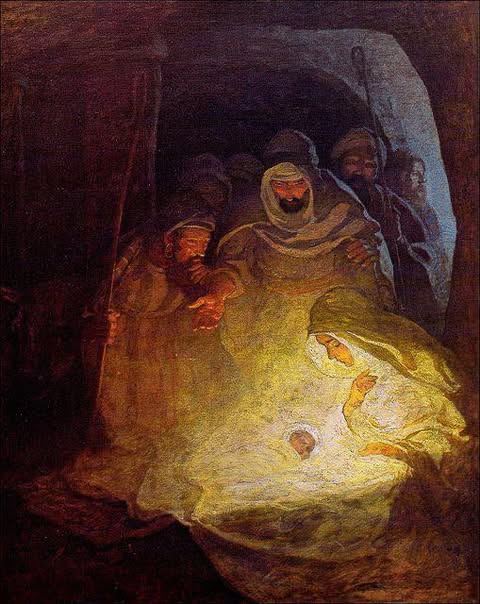
Christmas is not first and foremost the story of a child in a stable. It is the account of how reality's very origin did not remain outside its creation, but stepped into it - not disguised as idea, not elevated as philosophy, not manifested as power, but lived as man, with body, breath and vulnerability.
What happens on Christmas night is therefore not merely a birth, but a rupture in the world's deepest structure. It is that moment when the eternal no longer explains itself at a distance, but allows itself to be limited, so truth cannot merely be understood, but must be carried, lived, embodied.
The Word becomes flesh.
And it is no accident it happens in a stable.
For the stable is not romance, though it is often portrayed that way. The stable is precision. It points to the place where the low and the disordered dwell - not merely in the world, but in man himself. It is there where instinct, shame and fragility live side by side, there where we hide what is not proper, what smells, what we prefer to conceal from each other and from ourselves.
And precisely there God chooses to enter.
Of all places he could choose.
Not in the temple, where everything is cleansed and controlled.
Not in the palace, where power and self-righteousness reign.
But in the inner darkness, where man longs most - and hopes least.
It tells us something crucial about where to look, if we look for God. Not because God does not exist in the holy and ordered, but because man rarely encounters truth there, where it still has control.
So stay with me here.
The incarnation in the stable points to... that God seeks man there, where facades fall, where power loosens its grip, and where hope is thin - not to dwell in darkness, but to light a flame precisely there.
We can chew on that over the Christmas days, so let's move on.
Mary is therefore not merely a figure in the story, but an image of the consciousness that says yes, before it understands. You can understand it as WILLINGNESS, which precedes control, and as THE OPENNESS that dares to carry something it does not own, and which precisely therefore can become fertile. In her we see that TRUE TRANSFORMATION is never born of power, but of RECEPTIVITY.
Then there is Joseph, whom we often overlook. He stands by Mary's side - and he does so not as a supporting role, but as guardian. He is what we might call 'the righteous structure' or 'the inner backbone that protects the holy'. What emerges in us when understanding cannot quite explain it, even when the ego would rather retreat to safety. He is obedience to something greater than himself, the quiet strength that remains standing when everything else wavers.
The child that is born is also not merely a child.
The child is Logos. Not something new that arises in time, but the Word that was there from the beginning. The pattern, the meaning, the inner order through which all is created and held up by. Before the world took form, before time was measured, before man drew its first breath, Logos was already present - as the living structure in all that is.
When the Word therefore becomes flesh, it is not God losing his divinity. It is man gaining part in the eternal.
For it is not Logos that is limited.
It is Man. You and me.
The incarnation is not God ceasing to be infinite, but the infinite and eternal voluntarily stepping into the limited to illuminate it from within. Not to abolish man's nature, but to heal it. Not to flee from matter, but to redeem it.
The child is therefore not merely a sign of God's presence, but the very intersection where heaven and earth meet. Where the eternal touches the temporal. Where the infinite bends down, not in weakness, but in love, to show man the way home to what it has always been connected with.
God became man, not to cease being God, but so man no longer should live cut off from God.
Here lies Christianity's deepest axis - a truth so incomprehensible and profound that it cannot be understood once and for all, but can only slowly unfold in a person's life.
Still. That the shepherds are the first witnesses is also no accident. They are awake while others sleep. They are those who live outside the systems, without status and without stories to defend. They see, precisely because they do not have so much to lose - because their gaze is not yet darkened by power, ambition or self-deception.
And the wise men come from far away - from the knowledge of stars, from ancient wisdom, from traditions older than empires - and they bow, not in submission, but in recognition. They see that Christ does not stand opposed to wisdom, but is its fulfilment. That what they have spent their entire lives reading in signs, patterns and celestial bodies now stands living before them.
Therefore Herod must also be there.
For every time truth becomes living, Power reacts.
Herod is the fear. The ego. The order that senses its time is running out. For if this child is allowed to grow, all false authority will fall. And therefore power always tries to kill the child - in history, in culture and in man himself - as it always has.
Christmas is therefore not gentle.
It is dangerous.
For if God truly has stepped into Man, all excuses fall for living split - between body and spirit, between truth and action, between what we say and what we are. There is no longer any external instance to hide behind. Truth has been given face, hands and wounds.
And precisely therefore Christmas is still so disturbingly relevant.
In a world that again and again - and yes again in our time - seeks salvation through systems, ideologies, technologies and control, Christmas stands as a quiet but unyielding protest against all substitute gods. It reminds us that no state can save us, no market can give meaning, and no narrative can carry truth alone.
For truth has been given body.
And what we long for cannot be administered, mass-produced or mandated.
It must be born.
In man.
In history.
In you.
God became Man, so Man could become whole again.
And therefore Christmas leaves us without shelter.
Not before God - but before ourselves.
For when truth has stepped so close, when the Word no longer stands at a distance but has been given face, voice and life, then there is no longer anywhere to hide. Only an open space, a quiet interval, where the question unavoidably presents itself - unprotected and without escape routes.
Will we make room?
Room for truth.
For the Word that became man.
Not merely as thought, idea or philosophy - but as something allowed to shape our life. That we surrender to and let transform our heart?
For Christmas is not past.
And it is not merely tradition.
It is a repetition.
An entry.
An invitation.
The question is not whether the child was born then.
The question is whether there is room now - in the same low and dark space where it was once born.
Merry Christmas, friends. 💫
❤️🔥🪽