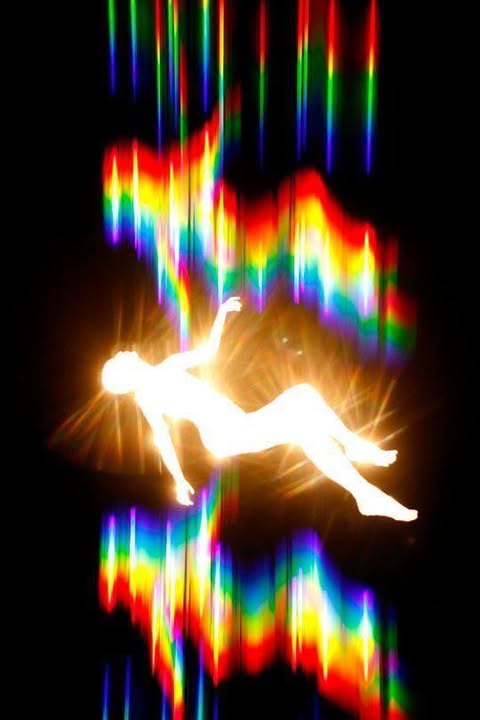
IMAGO DEI
To be created in God's image
There are few sentences in world history that carry more weight, more promise and more responsibility than this one. It lies like a glowing core in Genesis, and has done so for three thousand years.
"Let us create Man in our image, after our likeness," it says, and right there the entire Western civilisation begins, our entire idea of human dignity, freedom, morality, responsibility and soul.
It's hard to understand how violent that statement was in the ancient world. Not even kings were considered created in the image of the gods. They were merely stewards, placed in the world as small pieces in stories no one had full control over.
But then comes this Hebrew people - strange, stubborn, morally inflamed - and claims that every single human being, from slave to king, from woman to man, from child to elder, carries something divine. That in each of us there exists a spark, a mirror, a spirit that points directly into the very centre of creative power.
It was, and is - make no mistake - a revolution.
And that revolution created our entire idea of what a human being is.
The human being is not merely an animal. Not merely a resource. Not merely a means to an end. Not merely a member of a tribe, a class or a production. But a being with inherent dignity, responsibility and purpose.
From here comes our concept of conscience. From here our understanding of truth. From here justice, morality, love, duty and freedom take root. And that's why Christianity later speaks of the human heart as a temple, a dwelling for the Spirit, a place where God doesn't just create - but lives.
Once you've understood this properly, you also understand the conflict with modernity.
For the modern technocratic view of man - whether it's Marxist-materialist, bureaucratic, transhumanist, utilitarian or pure market logic - reduces the human being to something fundamentally less than what the Bible says you are.
It sees you as a piece in the production machine, as a function, as labour, as a data point, as a piece of identity-political raw material, as energy, as consumer unit, as something that can be optimised, regulated, measured and replaced. A resource. A stream. A statistical quantity.
It reduces you.
Limits you.
Cuts you off.
But a human being created in God's image is not a resource.
It is a mystery.
And precisely here the Bible meets the deepest esoteric traditions. The Rosicrucians, for example, spoke of "the inner spark" - the sacred light in man that doesn't stem from the world, but which the world cannot extinguish. They spoke of man as microcosm, a small version of the great cosmos, where the laws of the outer universe are also found in our inner, and where the divine language - Logos - can be discovered in the soul's movement.
The mystery schools in even older times in Egypt spoke of man as carrier of 'ka' and 'ba', a double nature where the body is a temple and spirit is a journey toward union with the Creator. Plato spoke of the soul as the reflection of form. John later speaks of the Word, Logos, the light that illuminates every human being, before the world even came into being.
All of it points toward the same thing -
That man is more than matter. More than chemistry. More than biology. More than psyche. More than history.
And more than the modern social narrative that attempts to obscure from you what you really are -
You are a being who in your innermost carries a reflection of the creative principle itself.
And therefore no system can own you. Not the state. Not the market. Not technology. Not ideology. Not the party. Not the collective. Not your class. Not your genes. Not your inclinations. Not your traumas.
You contain a freedom, a spark, a creative force that cannot be reduced, abolished, measured or fully controlled.
Read those last three sentences again.
Print them out.
Put them on your refrigerator.
Read them every day.
When Christianity says you are created in God's image, it doesn't mean you should resemble God physically. It means you are partaking in God's nature - understood among other things as will, intelligence, love, creativity, morality, the ability to create order out of chaos. The ability to speak truth into darkness. The ability to choose good, even when the price is high. The ability to bear responsibility, to create, to love, to shape yourself.
The ability to be free.
That's why the technocratic and materialistic ideologies of our time have such difficulty with Christianity. That's why it has been attacked so forcefully, and why we in this time experience that it must be spoken down again, ridiculed and problematised in pace with Europeans and Western peoples rediscovering it.
For if the human being is truly created in God's image, then it cannot be reduced to a resource. It cannot be planned like a harvest. It cannot be used as political fuel. It cannot be dictated by the collective. It cannot be dissolved into data. It cannot be made into something other than what it is.
For man does not stand at the bottom of the hierarchy.
Man stands in the middle of creation as its steward. As the one who shall cultivate, create, build, shape, love and lift - in God's spirit.
To be created in God's image is therefore both gift and burden. A promise and a duty. A reminder that you are carried by something greater, and that you simultaneously carry the greater within you. It is the foundation for everything called human dignity, freedom and morality. And it is simultaneously the greatest resistance force against any ideology that wants to reduce you to something less than what you are.
We lose ourselves when we forget this.
But we rise again when we remember it.
For it is not merely an idea. It is an identity. It is your origin. And it is your task.
You are created in God's image. And therefore you must live as one who carries the light - not as one who extinguishes it.
❤️🔥🪽
...
And for those who want to go deeper into the difference between Christianity and Islam -
To understand how revolutionary this idea is, one must understand that it is not universal. It doesn't just exist everywhere there is religion. On the contrary, it is the exception.
Most of the world's religions don't speak of man as carrier of God's nature - but of man as servant of cosmic laws, spirits or gods.
And nowhere does the contrast become clearer than in the meeting between Christianity and Islam.
Islam acknowledges that God created man, but not that man is created in God's image in the Christian sense. The Quran presents man as created by God, but as servant, as steward, as deputy (khalifa), as a being that should obey, but not as something that carries God's image or God-likeness in its innermost.
On the contrary. Islam emphasises that God is totally separate from creation. The Quran says: "Nothing is like Him" (42:11). That means no resemblance, no mirroring, no reflection. Man is not god-like. There is no imago dei.
God creates, man obeys. The connection is vertical, but not ontological - it goes through law, not through nature.
In Christianity, man is partaking in God's nature - as spirit, creativity, will, Logos. In Islam, man is first and foremost a creature whose value is determined by obedience to God's will. The highest ideal is submission (islam literally means submission) and piety, not transformation or god-likeness.
Therefore Islam does not say that man is God's children. That's a Christian thought. In Islam, man is God's servants.
Christianity builds its ethics on man's inherent dignity. Islam builds its ethics on God's law.
In Christianity, man is valuable because it is created in God's image. It has inherent dignity, regardless of faults. That's the root of freedom of conscience, individual ethics, forgiveness, human rights and the idea of the individual as carrier of inviolable value that lies in all of Western civilisation.
In Islam, dignity is derived from obedience. If you do what's right, you're rewarded. If you do wrong, you're punished. Divinity is not in you - it lies in the law, and you don't become transformed from within. You are evaluated from without.
The esoteric differences are at least as great. The Christian, Neoplatonic and Rosicrucian traditions speak of man as microcosm, a reflection of the divine macrocosm. The spark that dwells in you is Logos' own reflection. Therefore you can awaken, transform yourself, become more divinised. It's called theosis.
The Sufis have at times approached a similar thought, but when they said it out loud, it cost them their lives.
Historically, Sufis have been executed for precisely the unforgivable blasphemous thought and theological crime of suggesting a unity between man and God. For in Islam's core, God is absolutely separate from creation.
To the modern ear this may sound like a small detail. But these are foundations. And when foundations differ so massively in understanding of central principles - they create two vastly different civilisations.
Europe developed the individual, conscience, inner transformation and the idea of man's inviolability. The Middle East developed a law religion where faith, law and politics are one system, and where man's place is defined by the collective and law's order.
When man doesn't carry a divine spark within, it's far easier to subject all of life to a total order. That's why Islamic societies have historically been juridically totalising, while Christianity gave birth to individual freedom, breaking with authorities, truth-seeking rebellion and the idea of a people of free souls.
One needs neither doctorate nor diplomacy to see the consequence - two different gods create two different views of man - and thereby two different civilisations. Not as my personal assessment, but as a historical fact witnessed through 1,400 years.
So briefly summarised.
Christianity says - There is something divine in man that no system may break.
Islam says - Man is created to submit to God's law, and the divine cannot be mirrored in the created.
Both speak of God.
But they speak of two VASTLY DIFFERENT human beings.
….
Congratulations if you made it all the way down here.
Hope you got a bit wiser. 😊