Hear me out here. Even if you thought she wasn't for you. Neither the music nor her expression.
Hear me out anyway, now that her incomprehensible Light has been extinguished and she has passed away.
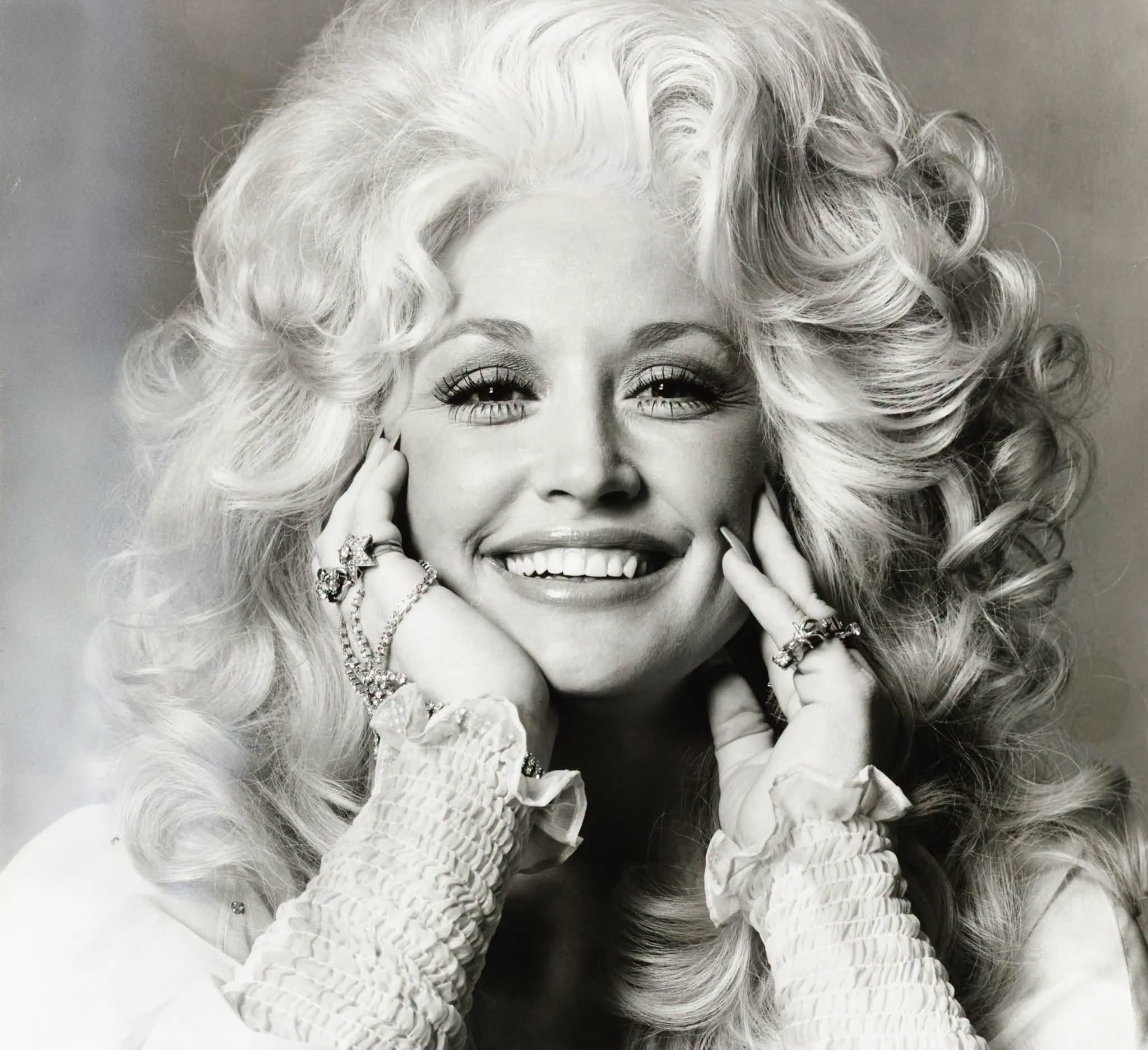
Look at the hands.
She holds them up to her cheeks a bit like a girl who's just been told something she doesn't quite dare believe, and there are rings on almost every finger, and the nails are long, and there are lace edges at the wrists, and over it all that wig hair, which nobody on earth has believed for a second, not even herself.
And yet. Yet there isn't a shadow of anything false in that picture.
That's the strange thing, the thing that always puzzled me when I was younger. Everything about her was constructed, and at the same time nothing about her was inauthentic.
How?
She was born in a cabin in Locust Ridge in Tennessee as number four of twelve, in a home where the father couldn't read, and where the mother sang the old ballads from the mountains while she cooked, and where the doctor was paid with a sack of cornmeal. There's nothing romantic about that kind of poverty, and she never pretended there was. She just wrote about it. The coat sewn from rags, which the other children laughed at, and which the mother had sewn after the story of Joseph, so each piece meant something.
That's her entire art in one song.
Take what you've been ridiculed for, and sing it, until the shame switches sides.
Clarity in itself.
Everyone - and I mean - EVERYONE can learn something here.
And then she did something nobody in that business did back then. She kept her own. When Elvis wanted to record I Will Always Love You, and his manager demanded half the rights, she said no - and then she cried all night about it, and she said no anyway.
Just under twenty years later Whitney Houston sang it, and you might be old enough to remember how it rolled over the world in half a year, while we sat in the dark and cried in secret over a bodyguard and a pop star who couldn't have each other - and meanwhile the money flowed in to a woman from a cabin without running water, who had understood something about ownership that men with law degrees hadn't understood.
She used it to build an amusement park in the valley she had fled from, so the people up there could get work, and to send books to children who don't own any, month after month, from birth until they turn five - in a number, and hold on now, that exceeds two hundred million.
There is apparently no bitterness to be found anywhere in that life. That's what I can't stop thinking about.
Especially in our time, where it has become fashionable to be a victim, and where the smallest word can send an entire grown person to the floor with the offense as their only baggage.
She actually had all the reasons. She was laughed at for her appearance, underestimated for her voice, treated as decoration for decades by men who couldn't write a single line of music like hers, and she didn't spend one minute of her public life demanding restitution.
She just took it. Quietly, laughing, with an enormous wig on and songwriting so precise that Jolene and I Will Always Love You were written the same evening.
Imagine that. Just banging out those two songs past midnight. Where did it come from? Only Dolly knows, because she could apparently just hear them, and then she pulled them out of the ether for you and me and everyone with ears. Thanks for that.
We've been told for many years that freedom for women should look like anger, like confrontation, like a permanent bill sent to the world. And then there stood a woman in the middle of it all, who owned her music, her business, her name and her marriage for nearly sixty years, and who never sent the bill.
She proved that you could take it all without becoming hard from it. This isn't a saccharine point I'm making here.
I'm writing it as the hardest thing a human being can do.
She grew up in her maternal grandfather's Pentecostal church and sang there before she sang anywhere else, and she left that churchgoing but never the faith. She didn't belong to any congregation and wouldn't let herself be enrolled in one, she just spoke to God as to someone who had been there all along, and she did it without a single apology, even when she sat across from very important people - like the Man in the Television or very clever experts who knew all sorts of very important things - who thought it was quaint.
That's why she shone. All the way. That's the Light you can see in the eyes and in the smile. Not because she was innocent, because she was anything but naive - in fact she was one of the sharpest business people in American entertainment. And not because there was never darkness, she herself has said that in the early eighties she sat so far down that she didn't know if she wanted to continue. But because she came back up without bringing the bill with her. Nothing was left inside that worked against herself.
That's what harmony with reality looks like. Beautiful patterns are woven around the Human when it stands upright in what it believes in, and there is no distance between the two things.
Available. For all of us.
They don't make them like that anymore, someone wrote.
I don't think it's about the factory, though. I think it's about us having stopped believing that goodness and strength can live in the same person.
She believed it. And she was right.
And was the finest example of it - for all the rest of us.
Godspeed Dolly ❤️🔥🪽