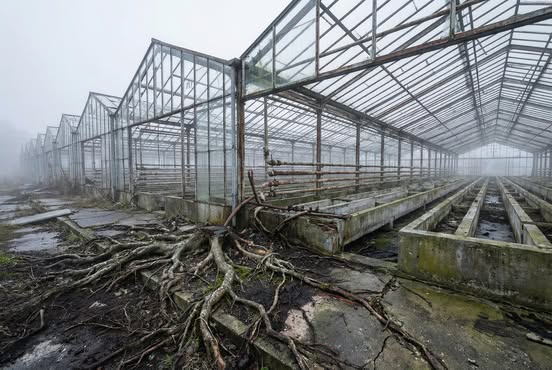
How did we end up here?
In the unreality.
Or. In a reality that, for many, feels displaced and unreal - where large parts of society rest on castles in the air, and where what was once self-evident now requires explanations, reservations and seven expert committees?
How did we end up in a world where words like freedom, responsibility and truth are still used freely, but in practice mean something entirely different from what they once did?
The sense that something has slipped sideways is not new, but it has become harder to ignore. Many experience that decisions are made far from themselves, that reality is filtered through systems that speak in a language without human warmth, and that their own experience is increasingly suspected if it does not fit into the models that have already been decided. It is rarely raw oppression one feels, but rather a quiet alienation, as if life is being lived in a landscape that has been drawn by someone who never lived there themselves.
If one wants to understand how we ended up here, it is not enough to point to individual political decisions or named institutions. One must take a step back and ask which ideas have slowly shaped our self-understanding, often without us noticing. For civilisations rarely collapse because they lack solutions - they lose their footing because they forget what assumptions their solutions rest on.
The crisis of the Western world - and especially the European one - therefore does not consist in our having lost our prosperity, our institutions or our technological capability. It consists in our having slowly lost clarity about who we are, and why our civilisation was even built the way it was. It is not a collapse with noise and chaos, but a gradual confusion, where concepts that once carried weight and direction have been hollowed out, and where basic assumptions have been replaced without real debate.
Here, Marxism plays a far greater role than many today will acknowledge, precisely because it rarely appears any longer in its open, revolutionary form.
To understand this, one must grasp that its most lasting and influential legacy is not the slogans of class struggle, but its view of humanity - the notion that the human being is first and foremost a product of structures, and that it can therefore be understood, improved and corrected through that fine term - structural intervention.
Once this thought takes root, it becomes almost inevitable to regard all of society's problems as technical tasks requiring management rather than judgement, and administration rather than responsibility.
And it is precisely here that Marxism's logic glides imperceptibly into technocracy - and the language has invaded Western systems from within.
Where Marxism in its original form would reshape the human being through conflict and upheaval, technocracy does it through regulation, standards and "correct behaviour". The means have changed, but the basic assumption is the same - that the human being in its core is malleable, and that "the best society" is one that is "correctly arranged".
Not morally anchored, but correctly designed.
In this thinking, politics gradually becomes detached from culture, history and morality and reduced to administration. Society begins to be treated, not as a living whole, but as a system that must be run efficiently. As large-scale production. As agriculture, where it is no longer about the nature of the soil, the rhythm of the seasons or the farmer's judgement, but about spreadsheets, standards and optimisation.
What was once cultivated with understanding of local conditions, traditions and experience is now industrialised, standardised and made independent of place. People and societies are treated as one treats crops in a modern agro-industrial system - standardised, packaged and made durable for long-term storage. Not to nourish life, but to be transported, regulated and controlled without regard for taste, nutrition or soil.
The result is foodstuffs that can last 80 years in a warehouse, but which no longer nourish the body. And correspondingly, societies that can be maintained administratively for generations, but which slowly lose what gave them taste, strength and resilience.
When politics becomes large-scale production, judgement disappears. When everything can be stored, we lose connection to what must be lived.
And then the question changes, so it is no longer about what is right, but what works. Not what the human being ought to be, but how it reacts. Not what is true, but what is expedient. The human being slowly ceases to be an end and becomes instead a problem to be solved - a quantity to be optimised, a behaviour to be adjusted.
We all know it - how all the blood drains from one's face when one wants to be Human, but everything has been made into system.
This is where the loss of identity begins.
For when the human being is no longer understood as a being with conscience, responsibility and rootedness in history and culture, but as a flexible product of its surroundings, it also loses its connection to what reaches beyond the system. Nations are reduced to administrative zones. Traditions become barriers. Family, faith and culture are degraded to private preferences without legitimate public significance. And the individual is left rootless, WHILE becoming ever more regulated.
The paradox is clear, but rarely articulated.
The more the system attempts to control the human being for its own good, the less responsibility is attributed to the human being itself.
The more society is organised around protection, security and correctness, the more fragile the individual becomes. And the more identity dissolves into structures, the greater becomes the void that no amount of regulation can fill.
This is where we stand now.
Western civilisation was never built on a romantic faith in humanity's goodness, but on a realistic recognition of its dangerousness - even when it means itself well. Therefore one built institutions, norms and boundaries that were to limit power, not gather it. Therefore one insisted that law must stand above power, that conscience could not be collectivised, and that the human being must never be reduced to a means for an abstract goal.
When this recognition is replaced by technocratic management and structural thinking, the West loses not only its freedom, but its self-understanding.
It forgets why its institutions exist, and begins instead to use them for purposes they were never created for. The result is not tyranny in the classical sense, but a soft, pervasive form of paternalism, where the human being is protected, regulated and corrected until it is no longer expected to stand on its own feet. Infantilised and made fragile - through learned helplessness - right up until words are perceived as violence and assault.
The decisive thing is therefore not individual laws, directives or political compromises, but the inner logic of the ideas.
Once one accepts that the human being is a means for the system's goals, the rest follows almost automatically. When truth and morality are made dependent on expediency and management, they can no longer be defended against power itself.
The West's crisis is therefore not primarily economic, political or technological.
It is spiritual and civilisational.
It is about whether we still believe that the human being has value before the system, or whether we have accepted that the system knows better than the human being itself. Whether we still understand ourselves as free, responsible beings, or merely as variables in an administrative calculation that the municipal lady needs to add up.
History shows that civilisations rarely fall because they lack solutions, but because they lose sight of what is even worth preserving. And when the human being first ceases to be an end and becomes a means, the foundation has already begun to crumble, even if the facade still stands upright.
That is where we stand now. And that is where we must begin to think clearly again - not by building more castles in the air, but by rediscovering the ground we once stood on, before we forgot why we were building in the first place.
The question that remains is therefore not technical and not political in the narrow sense either.
It is a civilisational question. For throughout this entire development - from ideology to technocracy, from culture to administration - there has lain a faint but persistent echo from those who built the world we still live off. A call from ancestors who knew that freedom is not a natural phenomenon, but something that requires character, boundaries and responsibility to survive.
This call is not only European. It is heard most clearly where the West's basic idea was formulated without circumlocution and without reservation, as in the American constitution, where it is stated that the human being is born with rights that are not given by the state, and which therefore cannot be taken by it either - a concentrate of Western experience. The recognition that power must always be limited, that conscience stands above the system, and that the human being must never be reduced to a means for a higher purpose, no matter how exalted it sounds.
Our allies on the other side of the Atlantic still maintain - often despite enormous internal tensions - this idea with a stubbornness that can seem old-fashioned in European eyes, but which in reality is an expression of historical memory. They know what happens when one lets go of it. They know that freedom cannot be administered into being, and that a society that attempts to manage itself to virtue ends up getting neither freedom nor virtue.
The question is whether we in Europe will hear the same call. Whether we will take up the baton that reaches back through generations, and resume the work of digging ourselves free of the ideological soup we have slowly sunk into.
Not by rejecting everything that has been built, but by again distinguishing between what must be repaired, and what should never have been allowed to replace the foundation.
For no society can live in the long run off castles in the air, no matter how well-regulated they are. At some point one must again have one's feet on the ground, take responsibility for one's inheritance and decide whether one will be administrator of systems - or bearer of a civilisation.
❤️🔥🪽