I have tried to let this article go - but it keeps sitting there like a splinter in my brain.
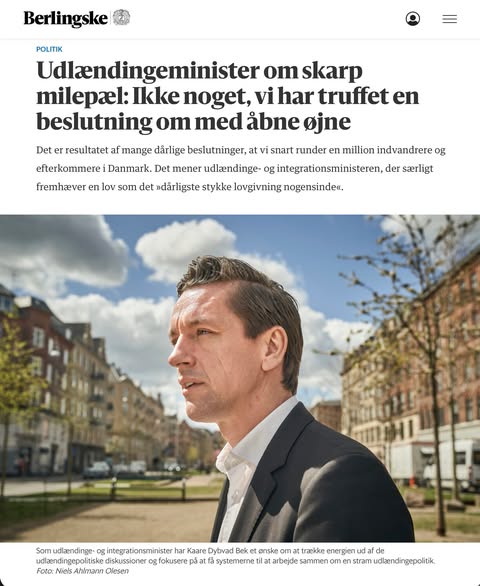
Because there is something almost touching about the way a minister in a proper suit can stand with his hands in his pockets and look out over the ruins, as though they built themselves.
"This is not something we decided with open eyes," says Minister for Immigration and Integration Kaare Dybvad Bek, as Denmark passes one million immigrants and descendants.
As though he is looking back at an earthquake, a natural disaster, something that just happened.
But then. It did not just happen.
Anyone who has been paying attention knows this.
It was decided.
It was planned.
It was defended.
And those who warned were shamed and shut out.
If something happened with closed eyes, it was not because no one tried to open them - but because the top of Danish politics, media, institutions, councilors and wise men and fuss for decades REFUSED to see.
Let us take the essential moments.
In 1967 they opened the borders for guest workers, and when thousands of Turkish and Pakistani families began to arrive the following year, they calmly told the population - "They will go home again." We were not asked. And no one held a referendum.
In 1983 they passed - what they called - "the world's most liberal immigration law" and called it humanism. They said it would only be a few thousand. It became - as predicted - tens of thousands, and later - as predicted - hundreds of thousands.
But. In Christiansborg - supported by the above - they called every critic obscurantists, xenophobes, "not presentable" and racists.
In 2004 the EU was expanded eastward. The politicians said a couple of thousand would come. Today Eastern Europeans fill entire neighborhoods and workplaces. And still - no consequence, no admission. About anything at all.
"It just happened," they say - as though it were cloudburst.
It did not happen in sleep.
It happened on purpose.
But not with truth.
And now our dear minister stands before the microphone and says that "...if we had shown the Danes the real consequences, they would have revolted..."
Yes. Precisely. Which of course was why they showed them nothing.
Instead they withheld everything they knew - and they knew quite a lot - from the ordinary population.
They held firm and kept saying that immigration was a gain. The more different we were, the stronger we became. And they wrote endless editorials and made fine economic models in the Ministry of Finance, predicting golden times and pluses on the bottom line.
And when the numbers began to speak their own language - crime, parallel societies, deficits in the billions - with no visible turning point as far as the eye could see and the calculator could project....
Then they closed their eyes harder.
It was never naivety. It was ideological.
A faith, cultivated with the same religious fervor, but without any grace for the growing group who watched in disbelief.
So what is Kaare Dybvad Bek actually saying?
He is trying to appear as a realist, one who admits the mistakes of the past. But he does it in a language that exempts the entire political class from responsibility. He calls it "something that happened". Like a weather change. Like pollen allergy.
But this is not allergy. This is architecture.
The Denmark we see today is built - stone by stone - by those who refused to look reality in the eye, and mocked those who did.
And the most disturbing thing is that it is still happening.
Today we talk about foreign labor and global mobility. We hear that 12 percent of GDP is created by foreigners. But as Dybvad himself notes - "It is also 12 percent of the workforce that are foreigners, so it comes out even."
In other words - No gain.
Only replacement.
Every time you create a suburban neighborhood in Skagen filled with Romanians, you lose a little more of the Denmark we once knew. Not because Romanians are bad people - but because no one any longer asks what kind of culture, people and community we want to be.
You are allowed to help.
You are allowed to cooperate.
But you must also dare to say - There are limits. Also for a people. For a society. For a Nation. That is, if it wants to persist in a recognizable form.
And this is where it pinches.
Because it requires more courage to say no - than to say welcome.
It requires greater responsibility to defend - than to give up.
It requires a soul to say - We will remain a recognizable self - as people and culture - and pass it on to our children.
Denmark has not become multicultural with open eyes.
It has become so with closed eyes - and closed mouth on anyone who asked questions.
Now the time has come to wake up.
And begin to speak.
And let us simultaneously note that the same mechanisms - used by the same know-it-all groups - are still in play in several of the most decisive and pressing questions and topics of the time, which will later cost us all at least as dearly.
If you are in doubt about which these are, you recognize them easily.
They are the topics where you may only have one opinion, if you want to avoid being branded as a bad person.
...
And I want to add this - both as admission and experience.
I did not understand it myself. Not until around 2015, when the images of hundreds of thousands of men on the highways from Syria hit the screen, and Europe responded with strange welcome flags and open arms.
I was - like so many others - raised thoroughly greased into the cultural Marxist lens that the media, pedagogy and entertainment industry had equipped me with from childhood.
A lens where the world is divided into two fixed roles: oppressors and oppressed.
The strong are evil, the weak are good.
Western societies are guilty, all others are victims.
No human being is just a human being - all are first and foremost representatives of a group, an identity, a power structure.
So when refugee streams moved up through Europe, we did not see individuals with complex motives - we saw only victims, whom we - "the privileged white Westerners" filled with guilt and shame and self-hatred over our privilege-blind lives - had a duty to receive.
But it was not compassion.
It was a worldview based on shame and debt.
And therefore one could not ask critical questions.
One could not talk about borders.
One could not even say "no", without being branded as cold, evil or far-right.
It took me years to discover that this narrative is not true - and that its consequences are deeply destructive. Not just for our society, but for the very possibility of living in truth.