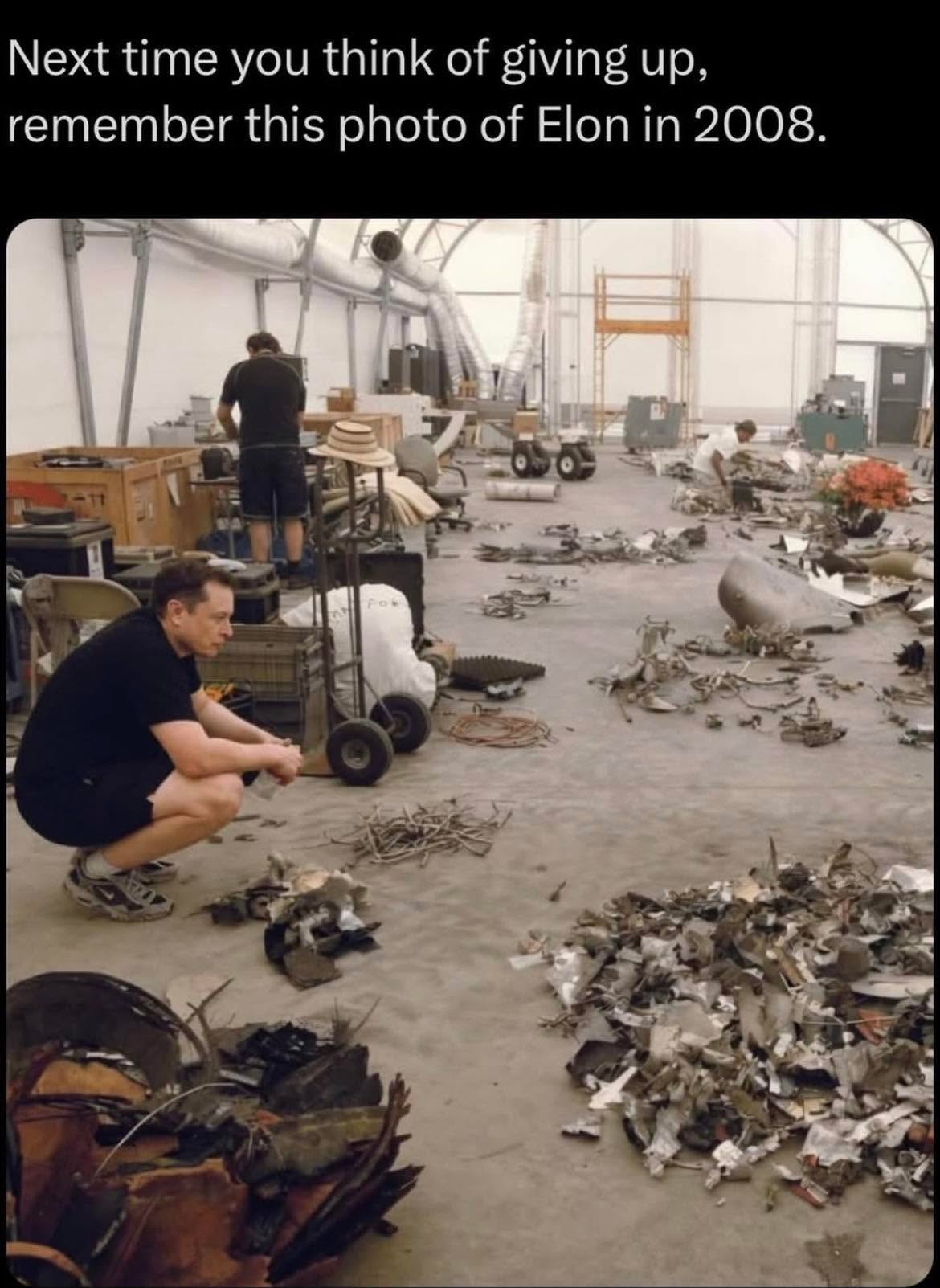
IF ELON MUSK HAD MOVED TO DENMARK.
It's a little wild to think about.
Imagine the young Elon Musk landing at Kastrup instead of America when he left South Africa as a tall teenager.
The same boy, the same restlessness, the same hunger to build something that didn't exist yet. He'd have sat on a bench somewhere in Copenhagen with exactly the same thing in his blood that he carried across the Atlantic.
And we would have taken care of him.
There's no doubt about that. Because that's what we do. We would have made sure he got a good education, a decent salary, and a healthy relationship with his own ambitions. We would have told him, quietly and kindly, that perhaps he should relax a bit. That he shouldn't think he was anything special.
That it would all work out, as long as he didn't stick his head up too far. Something about how you can't trust people who have money. And reminded him that it's all ours anyway. The money. It's just on loan from the state, which is better at deciding what it should be used for than he is.
And the world would never have seen SpaceX, Tesla, Neuralink, X, Grok etc.
I used to think it was just a feeling. A kind of national self-irony we went around telling ourselves, mostly to have something to laugh about together. But then I went through the numbers.
And the feeling held.
It held in a way, actually, that made me quiet.
There is not A SINGLE company in all of the EU, built from the ground up within the last FIFTY years, that has grown beyond one hundred billion euros.
NOT ONE.
In the same span, America created six companies, each worth more than a trillion. That's not a number a right-wing debater made up one evening. It's Mario Draghi, former head of the European Central Bank, who wrote it down, in a report commissioned by the EU itself.
And the Danish picture is just the European one, seen up close. The companies we - or some of us - are proud of here at home are inherited wealth.
Maersk is from before the First World War. Novo has roots in the twenties. Carlsberg is older than the Constitution. Almost everything we live on today was founded by people who have been dead for generations. The ONLY truly large company we've raised within half a century collects trucks and buys up competitors. But it didn't go to Mars, didn't transform an industry, doesn't deliver groundbreaking technology. It became a skilled forwarder.
And the few who actually had some of that wildness and imagination in them didn't stay here.
The young Danes who built something the world wanted packed up and went to San Francisco, because that's where it could become something. We didn't keep the talent. We watched it leave, and we called it luck for them.
But it would be too easy to leave it at culture. Because underneath it lies something harder, something that has nothing to do with mindset at all.
It's not just that Europe is twenty-seven markets instead of one, twenty-seven languages and regulatory systems and borders to drag an idea across before it can even call itself large.
It's that we've laid a layer of rules and administration over everything that grows faster than any company can grow under it.
In the US, a thing is legal until someone forbids it. With us, it's forbidden until someone permits it. That might sound like a small difference. But it's the entire difference between a continent that builds and one that administers what an earlier generation built.
Recently, the chair of the Conservative People's Party, Mona Juul, wrote a beautiful post. She dreams of a Denmark where entrepreneurial success practically grows on trees, and she's honest enough to present the numbers herself.
Last year, fewer companies started than any time since 2015. Of the thirteen Danish "unicorns" founded since the turn of the millennium, eight have moved their headquarters out of the country. Only thirty-six percent of new Danish companies are still alive after five years. She sees it. She sees all of it.
And then she still ends up where we always end up. With better framework conditions, lower taxes, something about "a culture where people dare" - without quite saying what it is we as a culture should change in our belief about the whole thing - and with her "believing in Denmark" and "wanting to give it a try."
It's beautifully meant, certainly - and it's completely powerless, because the dream is national, and the cause is continental.
She mentions the knobs a Danish minister can turn, and leaves the machine standing untouched that's actually stunting growth, the one sitting in Brussels, which no Facebook post from a Danish party leader can reach up to.
And the very unit she measures her dream in is the revelation.
A unicorn is a billion dollars - and a billion is naturally a lot of money - until you place it next to the giants that were never born here, where the threshold Draghi measured lies a hundred times higher - or for some of them a thousand times.
We're not just not building the giant. We've moved the finish line so far down that we're celebrating at the foot of the mountain.
She closes by saying she believes in Denmark. I actually do too. I just no longer believe that belief alone tears down a single significant rule.
On the contrary, it looks like they intend to bury us in more rules as far as the eye can see. And then you can "believe in it" as much as you want. Legislation is legislation.
Of course there's a "Musk" sitting in a boy's or girl's room here in the country - and talent naturally means something. But the structures you place the talent in mean even more.
And that's where we fail spectacularly.
The question was never whether Elon had something in him. He did, whether he sat on a bench in Copenhagen or in the US.
The question was whether there even existed a place here where what he dreamed of creating could grow at that scale.
For fifty years, the answer to that question has been NO.
Honestly, friends....
Shouldn't we get those structures changed?
❤️🔥🪽