Last week I wrote about the story of Hercules and the Serpent - and about what we are actually meant to take from such stories.
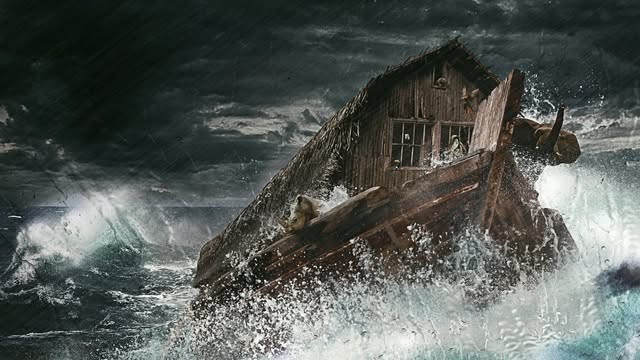
There I also mentioned Noah's Ark. A story that - like many other mythical narratives - can be read on multiple levels.
To the child it appears as a fairy tale - colourful, dramatic, image-making. But beneath the surface it carries a deeper meaning, which the child understands unconsciously - but which only truly emerges when we reread it as adults. With a different gaze. With experience. With longing for meaning amid the chaos we all must learn to navigate.
Allow me to share my own - perhaps slightly audacious perspective - where the entire story should be read as something that unfolds within every human being - one or more times throughout its life.
The story of an all-destroying flood, a divine cleansing, and a human who saves life by preparing in silence - is far older than the Bible.
It recurs across the entire world. From ancient Mesopotamia to India, from the Chinese mountain peoples to the Maya culture, from the songs of the Australian aborigines to the Nordic myths. Even the North American tribes have versions of a great water-escape that drowned the world and forced humanity to begin again.
Each time the same pattern follows.
Humanity loses connection with the divine.
Order breaks down.
A great flood devours all that no longer carries life.
Only those who understand and act in time survive - and bring something new with them into the next age.
These stories - scattered across time and place, yet strangely alike in their structure - call to us because they point to an eternal truth.
That chaos will sooner or later rise - in the world, in culture, in private life, in the mind - and that only those who are prepared will be able to stand through it.
And perhaps that is why the story of Noah and the ark still lives in us.
Not as childish fantasy and not as a frightening doomsday threat. But as a symbolic map to what happens when life - or God - or simply reality itself - rises up and demands all the dead be washed away.
At first glance it resembles a divine condemnation of a corrupt world. Humanity has become evil. The earth is filled with violence. God regrets that he created it all - and chooses to cleanse everything with a flood. Only Noah, his family and a handful of animals are allowed to survive. The rest is washed away.
But as with all the great biblical stories there are layers beneath the historical, beneath the theological - layers that open to those who ask with the heart and read with the soul.
And here the ark becomes not just a boat, but a metaphor. A model. An image.
For what if the story of Noah is not merely about a one-time catastrophe in humanity's distant past (which many are also debating vigorously these years) - but about the inevitable encounter between the human being and the chaos that life sooner or later will always throw it into?
What if the flood is the inner deluge that comes when the structures in our mind can no longer contain reality - when small personal "truths" are crushed, when identities crumble, and everything we thought was secure flows away?
And what if we - like Noah - must learn to discern, prepare and save the essential, if we are to survive what awaits?
In the story Noah is the only one who "walks with God".
He is not the strongest, wisest or most pious - but the one WHO LISTENS. The one who hears the inner voice. The one who senses that something great and violent is coming - and acts before it happens.
Therefore he begins to build.
Not to flee. Not to hide. But to be able to preserve and survive - and to carry something forward that would otherwise be lost.
For the rain comes. It always comes. Every adult human who understands its past knows this - and therefore can see into its future.
The ark is therefore a symbol of the inner temple - the protected place in the human being where connection to the divine can be preserved, even when the world outside collapses. The inner chamber where light is preserved under darkness's dominion.
What Noah builds is therefore a holy act - he holds fast to the true and the imperishable, amid the storm of time and soul.
For notice what Noah takes with him into the Ark.
He takes THE LIVING.
The animals, in pairs - male and female - represent life's many forces and currents. Instinct, strength, presence, longing. Life. And he sorts not merely by species, but by necessity. The dead, the inflated, the false, the unnatural gets no place. The genuine does. That which has life-force in it. That which is created in Logos' image - and not in humanity's perverted reflection.
And so it must also be in us.
When we sense that the flood is approaching - and we all do, sooner or later - then we must ask - (as several of you, like me, have certainly done) -
What in us is dead?
Which voices and desires in us no longer carry life?
Which inner habits, lies, self-deceptions, identities and dependencies must we leave behind in the rain?
What must die and be washed away?
And what must we take with us?
Which life-currents in us are holy and true?
Which instincts and forces are given to us as gift, not as curse?
Which sides of us should be protected and nourished, even amid what threatens to extinguish all?
Notice that the Flood is also baptism.
"The great purging".
It is God's and life's way of starting over. Not as destruction for destruction's sake - but as creation anew. A new beginning in life requires a cleansing. And we, who live in a time when much old rot festers in the foundation - in culture, in faith, in humanity's self-understanding - can perhaps sense that we stand before something resembling a deluge.
The modern world loves to laugh at the old myths. It reads them as childish stories, because it has itself become blinded by complexity and superficiality. But perhaps it is reversed. Perhaps the oldest stories still speak - not because they are simple, but because they are deeper than our modern thought-forms and patterns can contain.
For, for those who listen, Noah's ark is not a fairy tale for children.
It is a warning.
A guide.
A map.
Not for avoiding catastrophe - for it comes whether you want it or not, sooner or later - but for surviving it. And for carrying 'the living in you' across to the other side.
If you will build your ark, you must begin now.
Not when the rain falls - but while you still have peace around you.
You must learn to hear the voice.
To distinguish between what lives, and what merely pretends to do so.
To let die what must and should die.
And protect what carries life within it.
For then you will - like Noah - one day stand on new land. And know that what survived was what should go forward.
...
And as a sidenote -
In certain traditions Noah is called "the second Adam".
Just as Adam stands at the beginning of humanity's history, Noah stands at the beginning of humanity's rebirth. From Adam came humanity. From Noah - came the entire creation again. Not as a new evolution, but as a cleansed beginning. A new covenant. A new chance.
It is not accidental that Jesus in Christian theology is also referred to as "the second Adam". Where Adam brought 'separation', and Noah saved 'biological life', there Christ brings 'spiritual life' - and reunites humanity with God. Where Adam fails, where Noah saves, there Christ completes.
In this way the story of Noah also becomes a kind of prophecy. A portent. A pattern that repeats itself.
And the ark - both as concrete vessel and inner temple - points forward to that which in Christian tradition is called the new ark, namely Christ himself.
It is in Him - and in the space He builds in the human interior - that the living is preserved. Amid the storm. Amid the judgment. Amid the world's dissolution.
It is easy to read - but utterly tremendously complicated to fully grasp and see clearly, but I guarantee it is all invested time worth.
This is merely one of the deeper layers we can read from Noah's ark.
There are more. Many more.
And as it is with the great stories - those that carry eternal truths - they open only to those who dare to read beyond the visible.
And hear what is not said aloud.
Just like Noah.