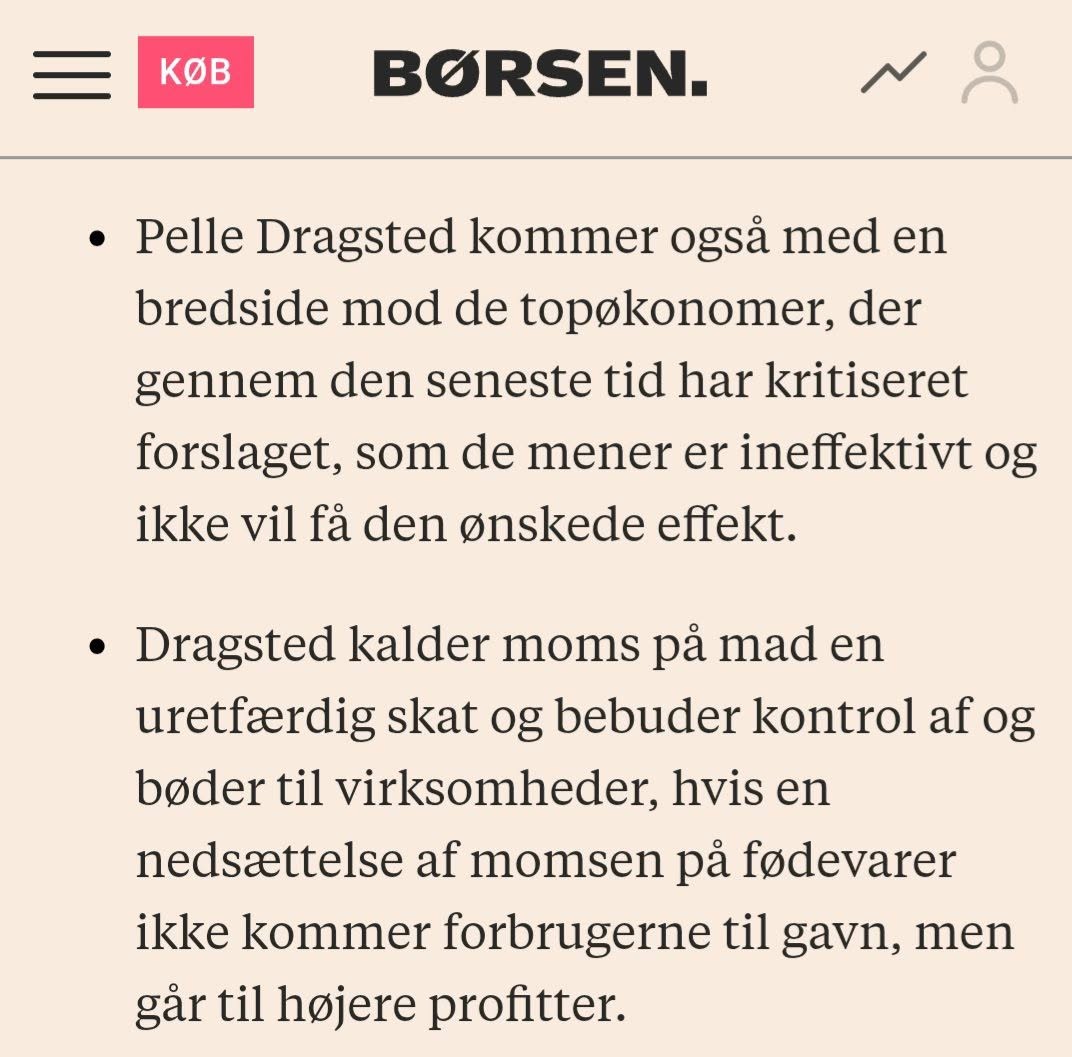
Pelle Dragsted wants to fine businesses and supermarkets if a VAT reduction does not benefit consumers.
Read that sentence again.
And then once more.
A member of parliament announces punishment for businesses for reacting to prices in the way prices have always functioned, everywhere, in all measurable time. That is not a position. That is an outright denial of how reality is put together.
And it struck me that we actually have a word for that kind of thing. We just never used it about him. Or about others.
We need to start introducing that.
For years we have had a concept that can end a career - climate denier.
One can think what one will about that word - and there is by now good reason to ask who profits from which curves - but the mechanism is not up for discussion. The one who gets the label loses his platform. He is not invited into the studio without a warning at the bottom of the screen. He is finished as a serious voice, because we as a society have decided that one must not deny science.
So let us take society at its word.
Because there exists a field of knowledge where the consensus is older, broader, and less dependent on models than anything else in the social sciences. It requires no supercomputers and no projections to the year 2100. It can be read in any queue in front of any shop with a sale. When the price falls, demand rises. When you punish investment, investment disappears. When you put a ceiling on rent, housing disappears. Economists who cannot agree on anything else whatsoever agree on this. The most tested, most replicated, most boringly well-documented relationship in modern social science. It is the field's law of gravity.
And Dragsted denies it. Not in a subordinate clause, not by accident, but as programme.
He is an ECONOMICS DENIER.
And he is one with a boldness that no other form of science denial would survive.
See where the experiment is running right now. In New York, Mamdani has frozen the rent for a million regulated flats - through a board where he himself appointed the majority, and whose only landlord representative resigned in protest with the remark that the decision was made during the election campaign, and everything since has been theatre. A city with record-high rental prices and historically low vacancy thus responds with the one intervention that the entire field across right and left has documented makes both worse.
On top of that come municipal supermarkets that are supposed to sell goods markedly cheaper than an industry whose total net margin sits around two per cent. The equation does not exist in this world. Either taxpayers pay the difference, including for the Wall Street director's beef, or the shelves go empty. There is not a third option, and everyone who has tried to run anything knows it.
And back home Dragsted sits and looks hungrily at it. Same faulty weave. VAT must come down, and if the market then behaves like a market, there must be control and fines. This is not economic policy. This is a punitive expedition against reality for not falling into line.
And I know what it looks like from the inside. In there, a price is not information about what something costs to produce. A price is something a greedy man has invented. The market is not reality - it is a narrative, capital's narrative, and narratives can be rewritten if you have the power and the courage. Seen from there, Dragsted's fines are not denial of anything. They are justice. You do not punish gravity, you punish those who insist it exists.
The problem is just that the queue in front of the shop does not care about the narrative. They have not read Foucault - and therefore do not know that it is a good thing they are hungry.
The queue appears anyway. The shelf goes empty anyway. The investor does not build anyway. One can call the price a social construction as long as one likes - it keeps doing its work, precisely as gravity keeps working on people who do not believe in it.
That is the uncomfortable thing about reality - it does not negotiate. It has not read the nice red manifesto. It just counts.
The climate denier, they say, denies measurements. But the economics denier denies something that does not even require measurement. He denies what every shopkeeper, every housewife and every twelve-year-old with a lemonade stand has always known - that you cannot sell below cost without someone paying the difference. He denies Copenhagen, where two generations of regulated housing market stands as a monument to the method.
He denies everything that has happened every time it has been tried, with the eternal formula that this time it is the right people pressing the buttons. This time they are doing it the right way.
So I propose that we begin using the word. Consistently. With the same seriousness, same raised eyebrows, same warning at the bottom of the screen.
Next time Dragsted or anyone else announces fines for businesses for obeying the price mechanism, the question from the journalist should be the same as any other denier would get -
"There is broader professional consensus against your policy than on almost any other field. Do you deny that research?"
And one could dream on.
One could imagine a public sphere where denial of reality actually had a price - where the man who announces punishment for those who react to his own incentives was met with the same quiet withdrawal of invitations, speaking time and respect that hits everyone else who speaks against their own field's accumulated knowledge. Not censorship. Not exclusion. Just the simple, symmetrical consequence that the one who denies the well-documented must argue his way back into the warmth instead of being carried in there.
But it does not happen. And the reason it does not happen is the entire answer.
Because the label was never handed out according to how certain the science was.
It was handed out according to how inconvenient the conclusion was. Dragsted denies the best-tested relationship in economic science, and he does it with a tailwind, because his denial feels right in the right circles - the circles that happen to write most of your news, and who know as little about economics as he does.
But one thing they know. They know how to hand out labels. They do it diligently, to everything they do not like.
So let us ask them.
Either the rule applies that one must not deny science.
Or it never really applied to the science - only to the power to hand out the word.
Which is it?