Following yesterday's post about the civilisational contradictions for which a bridge must be found between Islam and the Western world -
What one must understand, when speaking of integration and coexistence, is the fundamental asymmetry in the expectations.
For it is here the mismatch becomes clearest - and that for both sides, I think.
In the Western world today, it is expected that European societies should adapt themselves to Islamic norms, practices and sensibilities. Not fully and entirely, but to an extent that is marked and visible in everyday life.
It expresses itself as changes in school culture, in public morality, in dress codes, in food culture, in understanding of holy days, in the limits of free speech, in gender practice and in the social space.
I don't think any adults find it unusual that cultures influence each other - but the shift that has occurred over the last 30 years is no longer influence that happens naturally.
It has ended as expectation and demand.
And the decisive question - the one that explains the asymmetry - which almost no one dares ask, is this -
What would it look like if one made the same expectations the other way?
To make it clear, one must reverse the perspective. And I do not mean this as provocation, but as pure logical mirroring.
If the West must change itself to accommodate Islam, what would it look like, then, if the Islamic world should change itself correspondingly to accommodate the West?
Here the veil falls for anyone who looks honestly at it - and it may perhaps lead to clarity, and understanding of why the ordinary Western person experiences the shift that has occurred as they do.
For in Europe it is increasingly expected that we adapt our public space, institutions and norms, so Islamic practices can enter without friction. But if one mirrors that into the Middle Eastern context - if one imagines Riyadh, Tehran, Lahore or Cairo doing the same to accommodate Western norms - one stands before something that is civilisationally impossible.
Not because anyone is evil, and not because anyone wishes conflict - but because the two systems are built on different prioritisations of freedom, truth, law and social order.
What in Europe is perceived as small, reasonable adjustments would in the Middle East be revolutionary upheavals of everything from religious authority, gender practice, public morality, dress codes, speech space, family law and the relationship between individual and community.
It would entail -
That women go without headscarves in public space, that churches stand freely and visibly, that church bells ring out five times daily over the cities, that men and women move freely together without religious sanctions or surveillance from the local community or family, that all blasphemy laws are repealed, that crude satire of the most sacred texts and figures is tolerated, that Christian symbols are recognised in public space, and that the individual's freedom is defined as placed above the community's honour. Yes, even also above God.
Everyone understands instinctively that this is excluded.
The Islamic world would never adapt at this level. Truth be told, would not even consider it. And this we cannot and should not interfere with. It is their land, their faith, their way of arranging themselves - their wish.
And precisely therefore the asymmetry becomes obvious -
What is demanded of the West is demanded nowhere else. And what is presented as reasonable expectations in Europe would, in the countries where the tradition stems from, be perceived as directly unacceptable. And repeated demands for it would likely be met with arrest and punishment.
Integration, assimilation and inclusion in a society - incorporation into a worldview and civilisation - can ONLY function if the expectations are mutual.
When the expectations only go one way, it is not integration. Then it is transformation. And transformation of a civilisation's core values - without the other side changing theirs - leads inevitably to tension, mistrust and conflict.
This is what many Europeans and Danes experience. Perhaps without being able to put clear words to it.
This is what many have not yet understood. And this is what must be explained clearly -
That the demands made of the West only seem reasonable if one refrains from mirroring them. For if one mirrors them - honestly and symmetrically - one sees that the two systems cannot lie on top of each other without one in practice absorbing the other.
It is not a question of anger, racism or hostility.
Perhaps the opposite.
It is a question of civilisational architecture and construction. And constructions collide when they are attempted united without understanding of their fundamental differences.
I propose we make a high-resolution picture together, where we can clearly see what, where and why we stand where we do - and how we can get across it.
For the way it has been approached, through low resolution and strong emotions - has led to nothing but more of the same.
❤️🔥🪽
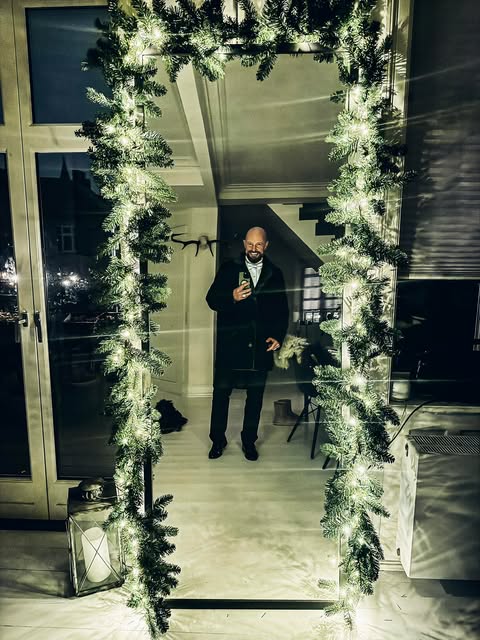
You can have a picture from last evening, when I came home late to a Christmas-decorated home.
A tradition which in some people's eyes is merely cosy decoration, but which in reality contains layers reaching far into our civilisation's history - and which can appear foreign from the outside, if one does not know them.
The evergreen tree as symbol of life in the midst of winter's darkness is older than Christianity. Winter green has for millennia been a sign of life force, of nature's promise that the darkness does not last forever. But Christianity - the one of the three pillars we stand on - did something with the symbol that no earlier culture had done. It took the raw and nature-bound, and gave it a new meaning - a spiritual direction, a narrative about man and about light.
The tree that originally was a sign of nature's survival became in Christianity a sign of man's salvation.
The evergreen tree became a symbol of eternal life.
And the light in the tree - especially the light at the top - became an image of Christ, the light that shines in the darkness, and which the darkness cannot overcome. This is why the tree stands there, in the midst of winter's darkness, as a testimony that there exists something higher than cold, chaos and destruction. Something that can guide, carry and orient.
And that is actually the point in this entire conversation, which we - the Western world - need to have.
That many of the things which today are regarded as "culture" or "tradition" - we have made into "decoration" in materialism - in reality are the civilisation's deepest architecture.
The Christmas tree is not merely decoration. It is a narrative about truth, dignity, freedom and light - the narrative our society is built upon. It is the light that makes it possible for Man to hold the course, even when the darkness draws closer.
I write none of these posts to expose anyone, or to problematise others' faith or way of life. I wish that all people can live and believe in accordance with what they find true. That is a fundamental part of the freedom our civilisation builds upon.
But I write it because it stands clear that the civilisational differences between the Western world order and the Islamic world order are so deep-lying that they cannot lie on top of each other without friction. Not because of ill will. Not because of hostility. But because the two systems rest on different understandings of man's nature, freedom, truth and order.
And when the foundations point in different directions, they collide. It is not a moral question. It is a constructional question.
And constructions cannot coexist if their foundation pillars are mutually incompatible.
Therefore we must be able to speak of this honestly - not to attack anyone, but to understand, protect and preserve what has made our civilisation the freest, most human-worthy and most luminous in history.
For without understanding the light that shines from the tree's top, one does not understand the society standing beneath it either.