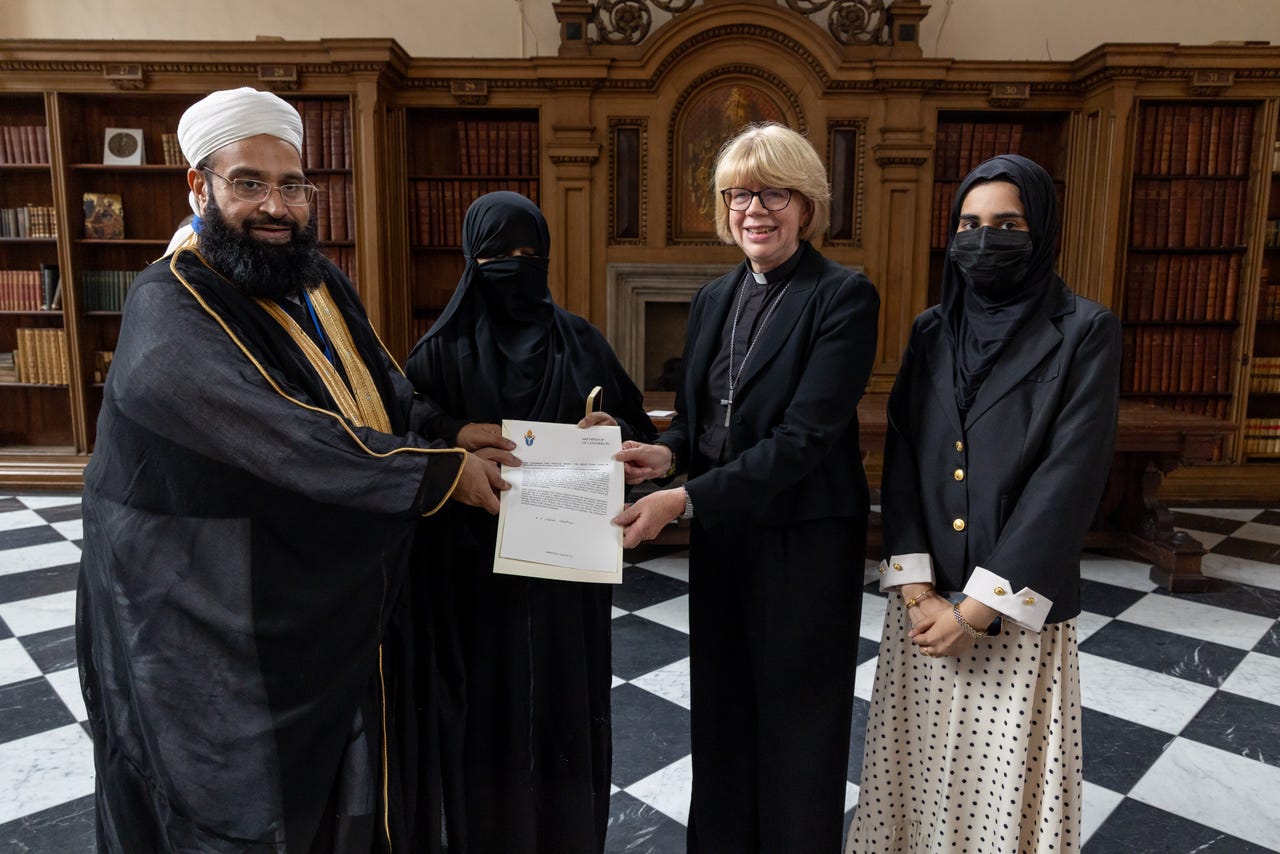
Look closely at the picture.
Not at the man. I'll return to him.
At the women.
There are three. Two of them - no one in the room has seen their faces.
Between them stands Sarah Mullally, the first female Archbishop of Canterbury in the history of the Church of England - the result of a long struggle over whether a woman could even stand where she stands.
We had to get all the way to 1994 before she could be a priest. To 2015 before she could be a bishop. To 2026 before she could lead.
Preceding that goes more than a hundred years of women's struggle in the Western world. Liberation from the chains of the past rested on one claim - that woman is created in the same image as man. With the same worth, the same rights, the same freedom.
An idea so centrally placed in the Christianity she stands upon that it has worked and won again and again - slowly, laboriously and not without setbacks - for over 2,000 years. All the way to where she stands now.
The picture is from September 11th. Twenty-five years after nearly three thousand people were murdered in Allah's name, she presented an award for "reconciliation and interfaith cooperation" to the chairman of Pakistan's Ulema Council. Beside him - his wife.
Covered so only halves of her eyes could be glimpsed.
The Church of England wrote the caption itself - "...and his wife" - and not one word more.
No one in the hall - and no one in the editorial office and communications department - saw anything that needed explaining.
In that room, it apparently wasn't the women with cloth over their faces who couldn't see. It was everyone else.
When criticism came, for of course it did, Lambeth Palace responded that in interfaith dialogue one must *meet across deeply felt differences*.
That's true.
The difference in the picture is whether a woman may have a face.
Here at home we've been told, by one of the country's sweetest and most well-integrated Muslims, that it's one of the most feminist things a woman can do. To put on a niqab, "where you're just ninja". Verbatim. His own word, on tape. And film.
We men want to see you, but you can see us, and we can't see you.
That's what feminism sounds like when it's been translated into another order, Islam, which I often write about.
Read the quote again and notice who is the subject in it. For it's not her. It's us. Her freedom is defined by what we can see.
And here it stands then, the translation.
In Lambeth Palace's finest hall, beside the woman the Archbishop's seat in Canterbury spent ONE THOUSAND FOUR HUNDRED YEARS allowing to stand in front.
It's two views of woman in one photograph. One has fought its way to a face. The other has had hers covered completely - and we've learned to call it a choice one mustn't question. For God's sake. Not a single question about that - you're not indecent!
Later in the week it then emerged that the same Pakistani council in 2007 gave its highest honour to Osama bin Laden. They gave it to him as a protest against Salman Rushdie receiving a knighthood.
And THEN of all things, the Church of England withdrew the award.
Notice the order.
Not the picture. The quote.
Had no one found a nineteen-year-old quote, the award would still hang there. The picture alone would never have brought it down. For there was no one in the entire institution who saw it as a problem - neither when the award was given, nor when it was taken back.
The man has incidentally done something real for Pakistan's Christians - and that must be said without equivocation - for this isn't about him. Just as none of my posts are about the individual believing Muslim.
It's about what the institution can see.
The Church of England can find patriarchy in its own prayer book from 1662.
It can hire auditors to dig through its own archives - which it did in 2019 - and find a fund from 1704 that invested in a company that sailed with slaves.
It can apologise - which it did in 2022. It can set aside a hundred million pounds in reparation - which it did in 2023.
And when its own council declared the amount insufficient, it accepted a new target - a billion. A nice round number. *A moral imperative*, the church calls it.
The sin is three hundred years old. Everyone who committed it, and everyone it was committed against, has been dead for two hundred years.
Feel the full weight of that.
A church can see three hundred years back in its own accounts.
But it cannot see what stands silently in the middle of its own photograph, two metres from the archbishop. For it has received a new name. It's called culture now.
And culture we've learned from the Man on Television - we mustn't see it, notice it or comment on it.
For the chains of the dead, one gladly pays a billion.
The woman without a face in the hall didn't cost even a question.
The mistake they withdrew.
The picture still hangs there.
We have a word for that sort of thing in the Western world - do any of you know it?
❤️🔥🪽