Last Sunday, AfD won the state election in German Saxony-Anhalt with 43.8 percent of the votes. It is the largest result a party to the right of centre has achieved in Germany since the Second World War, and the party was three seats short of being able to govern alone.
The interesting thing is just not the result. The interesting thing is what happened afterwards.
Sunday at 6 PM, the polling stations closed.
At 6:01 PM, the explanations began.
Not the questions. The explanations.
There was no one asking why, because the answer already lay ready in the drawer, folded and ironed, and the only thing the numbers were to be used for was to determine which of the ready-made answers should be drawn first.
The Chancellor was first to pick, so he naturally drew "Russia".
A state with 2.1 million people had spoken, and the Chancellor looked east and noted that 2,500 kilometres away, there were some who were pleased. Which is undoubtedly true. But it is still an interesting understanding of democracy that an election result should be judged by who smiles at it in Moscow, and not by who cast the votes in Magdeburg.
By that standard, Putin has also won every time a German train departure is cancelled.
Then they drew "disinformation".
The voters had been manipulated, they said, by algorithms and campaigns and dark forces on the internet, and it is an explanation with the pleasant property that it can never be disproved and never needs to meet a single voter.
The man whose town has changed face in fifteen years has not seen anything with his own eyes that made him put his cross there. He was told it by a chatbot. The man has lived on his street for forty years, but the algorithm has apparently seen it better than he has.
Then they drew "protest".
"The voters didn't really mean it", it was said, they just wanted to send a signal, and by now it is a signal that has been sent so many times and so loudly that one would think someone would pick up the phone. But a signal that has been sent every year for ten years and never answered is no longer a signal. It is a message the receiver refuses to acknowledge.
In 2021 it was protest. In 2024 it was protest. Now the protest stands at 43.8 percent, and it is still not an opinion the voters have.
Next time the protest stands at a hundred percent, and it will still not be an opinion.
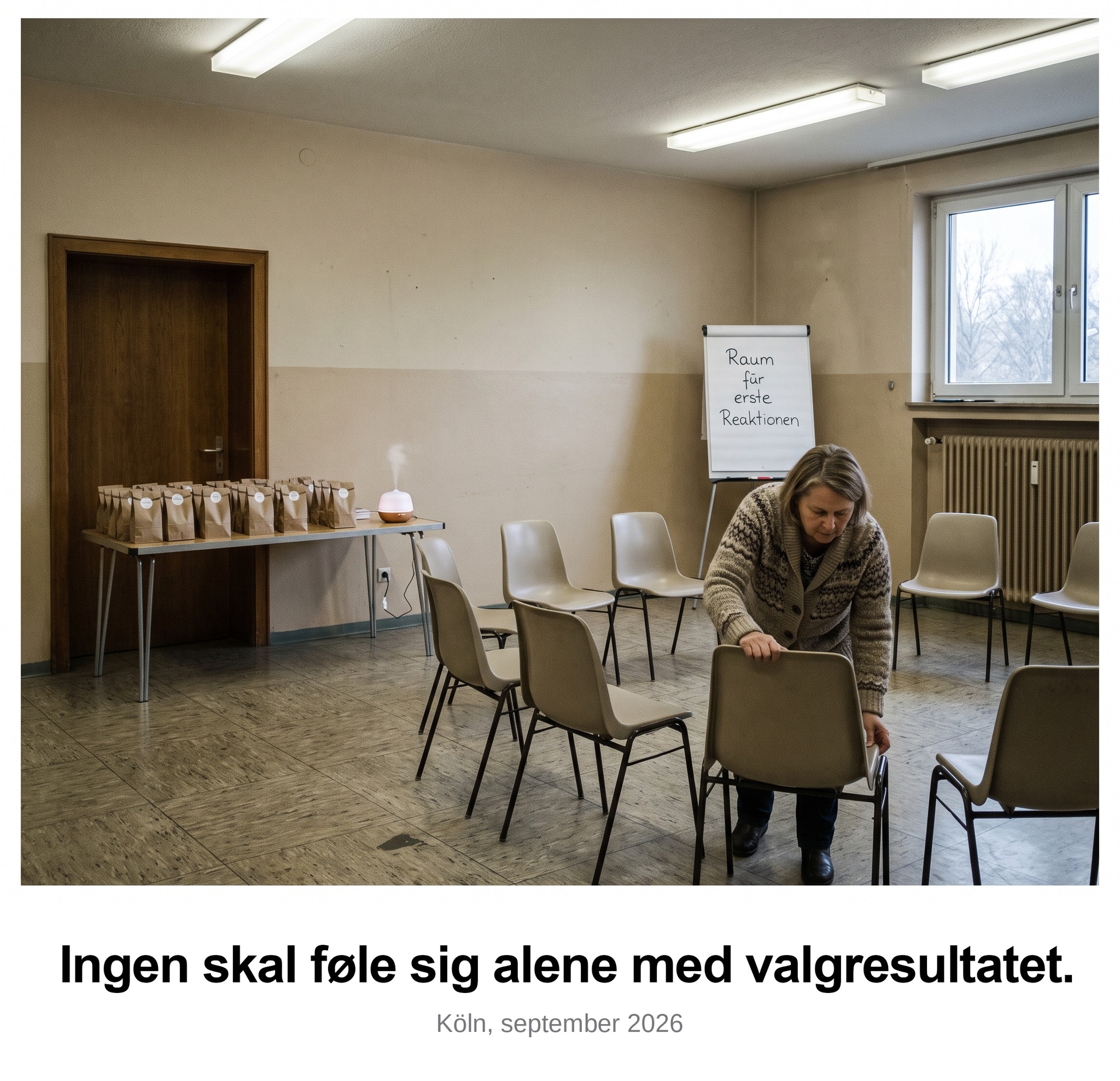
And in Cologne - and I swear this is not satire, it is a press release - there they invited citizens to an event that was to provide "space for the first reactions, protest and analyses"...
One imagines it.
Dimmed lighting. A diffuser with lavender in the corner, because research shows that lavender lowers the pulse in those first-time affected by election results. Breathing bags in recycled paper at the entrance, one per participant, more can be requisitioned. A certified conversation facilitator who, with a calm voice, reminds that there are no wrong feelings here, only wrong voters, and that it is okay to feel what one feels, as long as one does not begin to think about why one feels it. There is a sensory room for the hardest hit, with soft cushions and a playlist that has been quality-assured for trigger words like "border", "people" and "majority".
And finally a collective exercise, where one in a circle puts words to one's grief and arrives at the liberating realisation that it is not oneself who has lost connection with the voters - it is the voters who have lost connection with oneself.
An election result - anyone must understand - is in 2026 no longer a message from the people to power. It is a trauma that must be processed. One gathers, one breathes into the bag, one moves on together. Democracy as grief group, where what has passed away is one's own electorate.
What is remarkable is what was not drawn up from the drawer. Namely the explanation that the people in a state of 2.1 million have looked out of their own window, on their own street, in their own town, and voted according to what they saw. That Reality, as experienced by those who live in it, could be a sufficient reason.
That explanation does not exist in the drawer...
It is in fact the only one that has never lain there.
And then the calculation that no one does aloud. For five years - for five solid years - one has built firewalls, monitored the party as confirmed extremist, debated bans and refused any contact.
The result of this strategy is that the party has gone from 21 to 44 percent.
If a brewery had spent five years warning customers against their own best-selling beer, and sales had doubled, one would fire the marketing director. In German politics, one promotes him to lead the working group - because naturally a working group was established, which is to investigate whether one can ban the party that almost half the voters have just voted for.
The voters gave the wrong answer, so now one is investigating the answer.
Voter turnout rose, by the way, from 60 to 78 percent. Had the new voters voted correctly, it would have been called a democratic celebration, a popular spring, a rebirth of engagement. Now it is called a worrying development. Democracy is apparently when the people participate - democratic crisis is when it participates too much in the wrong direction.
One voice, by the way, stood out in the chorus. Josef Schuster, chairman of the Central Council of Jews in Germany - that is, the man from the institution that has most to fear and least reason to embellish an AfD result - said quietly that the success is primarily due to the fiasco of the parties that have carried the federal republic for decades. One sentence, and the entire explanation industry was superfluous. It was noted. And put back in the drawer, filed under Russia.
There is a particular irony in that it is precisely there that it happens.
In the old GDR, where for forty years one knew better than the people what the people meant, and where Brecht once dryly suggested that the government could spare itself the trouble and simply dissolve the people and elect itself a new one. Back then it was meant as satire. Now it has a case number and a working group.
The Germans have spoken. Now they sit and wait to be told what they said - and what they are allowed to mean.
🤓🤷♂️