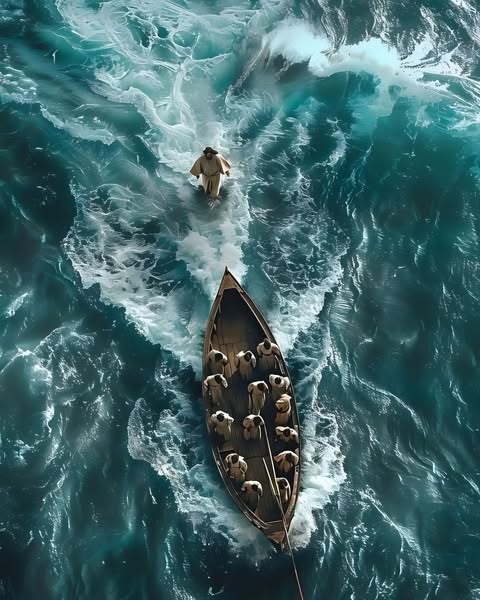
THE STORM.
And the cure.
Let us continue the journey into the old stories - not to romanticise the past, but to lift the meaning out of them, so they can mirror themselves in our time and reveal something about us. The Bible's narratives are not museum pieces. They are maps of the human psyche. Maps of reality. Maps of how a life - and a civilisation - is led out of chaos and back toward order.
And there is one story I have wanted to write about for years.
One scene that contains the entire span between man's fear and his calling. One sentence that shows the difference between sinking and being carried.
So buckle up.
For when we understand this narrative, we also understand our time.
...
There exists a moment in the Gospel that in itself contains man's entire psychological and spiritual condition. A moment where Faith is not a question of dogma, but of attention and direction.
In this one scene lies an insight that speaks directly into our time - a time marked by relativism, lies, and the loss of meaning. We see it everywhere in the culture - people who no longer know what is true, because they no longer know what to fix their gaze upon.
In this narrative, Jesus does not just show what - or who - God is. He shows how Reality functions.
At this point in the story, Jesus has just taught a large crowd. Evening falls, and the disciples sail out on the lake in a boat, while Jesus stays behind to be alone and pray. In the middle of the night, a storm rises. The waves strike against the boat, the wind picks up, and the darkness makes it difficult to see what is happening around them. Fear sets in - as it does in every human being when we lose control. The body tenses, breathing becomes high, thoughts race.
Suddenly in the midst of the storm, the disciples see a figure approaching - walking on the water.
They first think it is a ghost. Panic escalates.
But it is Jesus - and he says the words that have since carried people through millennia -
"It is I. Fear not."
Peter - impulsive, alive, driven by a longing for more than a life in fear - answers - "Lord, if it is you, tell me to come out to you on the water."
The disciples are not evil or petty. But even though it is not written anywhere, I imagine that they do what people do when fear takes over - they try to hold each other fast in the safe. So surely, in their panic, they shout at Peter. They want him to stay in the boat. Not because they do not wish him well, but because they cannot imagine that anything can carry him outside what they themselves understand.
And that is how it always is - when you rise after truth, people around you - even those who love you - will try to hold you back. Not out of ill will, but out of fear.
They shout - "Stay here! This is madness!" for the unknown provokes those who have settled into the known.
The boat therefore represents, at one layer, security, comfort, the familiar narrative. The water represents movement, faith, the soul and direction.
No one shouts to Peter that he should jump. Everyone shouts that he should stay. But the call does not come from the boat. The call comes from the place that lies outside explanation - out on the waves.
And Jesus does not give an explanation, no guarantee, no account. He simply says -
"Come."
And here something happens that is more than a historical moment - it is a psychological, spiritual and deeply human moment.
Peter steps out of the boat. He places his foot on the water... And the water carries.
Not because the water changes.
But because Peter does.
In the moment his gaze is fixed on Jesus - on Truth, on Logos, on the only point in the world that does not shift form - everything in him falls into calm. His body does what his mind otherwise would not allow - he walks. He does not walk on water. He walks on direction. He walks on attention. On Order. He walks on meaning.
And he can feel it in his body.
As long as the inner gaze is fixed, reality carries him.
And so it is also with us. When our attention rests in Truth - in something greater than ourselves - the problems do not fall away, but they lose their power over us.
It is only when Peter begins to look at the waves - at the storm around him - doubts that he really can... that he begins to sink.
Again.
Not because the water changes.
But because his focus does.
I have often heard modern people say that this story is solely about faith versus doubt. But seen through the lens of biology, it equally concerns attention and the design of the nervous system.
When a human being has one clear direction, one thing that orients its actions, a calm is created in the entire organism - from breathing rhythm to hormonal balance. Our nervous system is built - designed - to follow what we fix our gaze upon. In modern neurology it is called 'orienting response' - translated - what we direct our attention toward automatically becomes what the body orients itself toward.
Dopamine, which many mistakenly think is merely a "reward substance," actually functions as a landmark. It is not released when we reach a goal, but when we move toward what we have set as direction.
In other words - dopamine is not pleasure. It is purposefulness. It tells the body - "Continue. You are heading the right way." When direction is clear, the body falls into calm. And conversely - when direction, meaning and aim are split - when we try to keep all possibilities open at the same time - unrest, anxiety and self-sabotage arise.
Seen through this lens, Peter does not sink because his faith disappears. He sinks because his attention disappears.
Not from Jesus as a person, but from the point where his attention creates what we can call 'inner gathering'. In the moment he lets his gaze wander to the waves and to the risk around him, his nervous system loses its direction, and his body reacts as our bodies do when we are confronted with too many conflicting impulses - we tense, we doubt, and we lose our footing.
The storm and the waves are symbols of what constantly tries to steal our attention - the news flow that must keep you afraid - social media that must keep you outraged - the notifications that must keep you dependent - culture's demand for constant self-optimisation - the hunt for recognition from people who mean nothing - economic pressure that makes you feel you are never enough - expectations from outside that drown out longing from within - identity politics that splits instead of gathers - constant comparison that dissolves self-worth - the fear of being shamed if you mean something true..
The storm is everything that wants you to look outward instead of inward. Everything that wants you to lose sight of direction and truth.
The spirituality the Bible describes is therefore not a break with Reality's Laws - it is a deeper fulfilment of them.
When attention is gathered, and we move in clarity, we can go places we did not think possible. When it fragments, we sink in what before carried us.
Breathe. Sink it. And think.
If one understands this moment between Peter and Jesus, one also understands what is happening with the Western world these years.
For several centuries, the West had a common fixed point - ONE DIRECTION UPWARD.
It was not blind religion, but a deep cultural anchoring in the idea of truth, order, meaning and responsibility. It gave people and societies an inner compass. There existed something higher than the individual, and therefore something the individual could direct itself toward.
But gradually - from the moment we made ourselves God - the gaze began to shift. Not just from God - but from Truth as principle.
We began to orient ourselves toward feelings rather than reality, toward comfort rather than direction, toward individualism without responsibility. Truth became relative. Identity became detached from reality. We replaced Logos - meaning, order, truth, direction and purpose - with "my truth."
And notice what happens.
When a human being does this, it sinks.
When a society does this, civilisation sinks.
And like Peter, today we are not looking at what can carry us.
We stare fixated at the waves.
We see danger, chaos, crises, climate, racial tensions, economic storms, ALL THAT CAN GO WRONG - and try to control them by reacting to fear. But no culture can navigate by what it fears.
A society that wants to Flourish, Be Nourished and Live - can ONLY navigate by what it regards as true.
The West is not going under because someone threatens us from outside. Although many certainly smell blood, and are working to go for our throats these years.
The West is going under because we have removed our gaze from Truth.
For Truth - whether you understand it as Christ, Logos, order or Reality's Nature - has always functioned as centre. Without a centre there is only movement. Without direction there is only noise. When a human being no longer knows who it should be, it becomes anxious. When a civilisation no longer knows what it should be, it becomes chaotic.
Peter does not sink because the sea is deep. He sinks because his gaze no longer rests on what can carry him.
That is how people sink.
That is how societies sink.
The conclusion is simple, and it applies both to you, me, and the entire Western world -
What we fix our gaze upon,
becomes what we move toward.
And what we move toward,
becomes what shapes who we become.
When the gaze rests on TRUTH, Reality carries us.
When the gaze rests on FEAR, we collapse under our own weight.
❤️🔥🪽
...
And as extra observations for those of you who - like me - want the bottom.
Peter sinks. Not dramatically and suddenly, but in the way a human being sinks when direction and reality slide out of its hands - slowly, quietly, almost imperceptibly. He has already felt that the water carried him, and that the impossible was possible, as long as his gaze was fixed and his inner gathering intact.
But in the moment his attention shifts from Truth to the storm around him, he loses the connection that carried him, and the body reacts as our bodies always do when we lose direction - it panics. And it is only there - not before - that Jesus moves. He does not shout, he does not explain, and he does not reproach. He reaches his hand forward.
Esoterically, that moment is the entire point - Truth does not wait for our perfection. It responds to our gaze.
It is not Peter's strength or willpower that saves him, but the moment attention again finds its centre. The connection is re-established, and he is lifted up - not just from the water, but from the inner dissolution that made him sink.
And notice what happens...
Jesus does not walk back to the boat alone, he walks together with him. They walk side by side through what is still waves and wind. Through the storm. The miracle is not only that Peter could walk on water. The miracle is that when Man turns his gaze toward Truth, Truth walks with it.
And only when they step into the boat does the next thing happen, which is almost always overlooked... Jesus speaks ONE sentence, and then the storm stops!
Not gradually, as when we try to control the world with our will, our plans or our anxiety, but instantly. As if Reality itself falls into calm, in the moment it recognises its own order.
For TRUTH has always had that quality - it brings the restless to calm, not by fighting it, but by orienting it. The storm does not stop because the world changes - it stops because the gaze does.
And here the parallel to our time begins to take shape. For we live in a civilisation that resembles the disciples' boat more than anything else. We find ourselves in a collective storm of dissolution and distraction, where truth has become relative, where direction has been dissolved into personal feeling, and where we as a culture have turned our gaze away from what can carry us. Instead we stare at the waves - the crises, the conflicts, the identity struggles, the fragmentation, the constant streams of information and indignation that demand our attention, until we can almost not feel ourselves.
We try to handle the storm by reacting to it - with more regulation, more control, more panic. But NO civilisation can navigate by what it FEARS. It can ONLY navigate by what it ORIENTS itself toward. And we do not know - and do not agree at all on - what that is, at the moment!
Jesus' action in the boat is therefore not just a miracle - it is a model!
He stops the storm by centring attention again. He speaks into chaos with clarity and direction. And that is precisely the moment that calls to us today - not as individuals, but as culture. For the Western world is not sinking because the waves have become too big, or because the enemy stands at the gate. We have handled all that before. No, it is sinking because it has removed its gaze from Truth, and when the gaze no longer rests on what gives direction, everything else takes over - the noise, the fear, the fragmentation. Esoterically speaking, the scene with Jesus and the storm shows that order only returns when Truth again becomes centre. Not when people become stronger, but when attention does.
That is the same call we stand in now - to gather the gaze again. To let truth have first place, not our convenience or our fear or our identity. To speak into chaos - not by shouting louder than the storm, but by STANDING FIRM in what is true.
For the storm only stops when someone rises up, stands firm and says - enough!
Enough relativism. Enough lies. Enough division. Enough self-deception.
Truth is not to be negotiated forth - it is to be pointed at.
When the gaze again attaches itself to what can carry, the waves fall into calm. That is how man functions. That is how culture functions. That is how reality functions.
That is why this moment is not just an old story, but a model for leadership, culture and civilisation. Jesus shows that storms are not handled by standing in the boat shouting at the wind, analysing the waves or discussing whether the water feels unjust.
Storms are stopped when the one who has direction rises up and speaks truth into chaos. We live in a time where everyone shouts, but no one speaks. Where everyone reacts, but no one directs the gaze. Where institutions, media, politicians and leaders have given up truth, because they believe that peace is achieved by compromise with lies.
But storms cannot be negotiated with.
Storms stop when someone stands in Truth.
That is why this is the Western world's calling in these years - to stop reacting to the waves and begin to exercise authority over them. To gather the gaze, to stand firm, and to say what is true - not because it is popular, but because it is the only thing that makes the sea lie down.
We cannot save the world by running between the waves - we can only save it by lifting the gaze and pointing to the fixed point that never moves. When a civilisation again orients itself by truth, everything else falls into place. Not because the storm disappears, but because it loses power.
Truth is not a viewpoint.
Truth is a force.
And that Force is waiting - right now - for someone to use it!