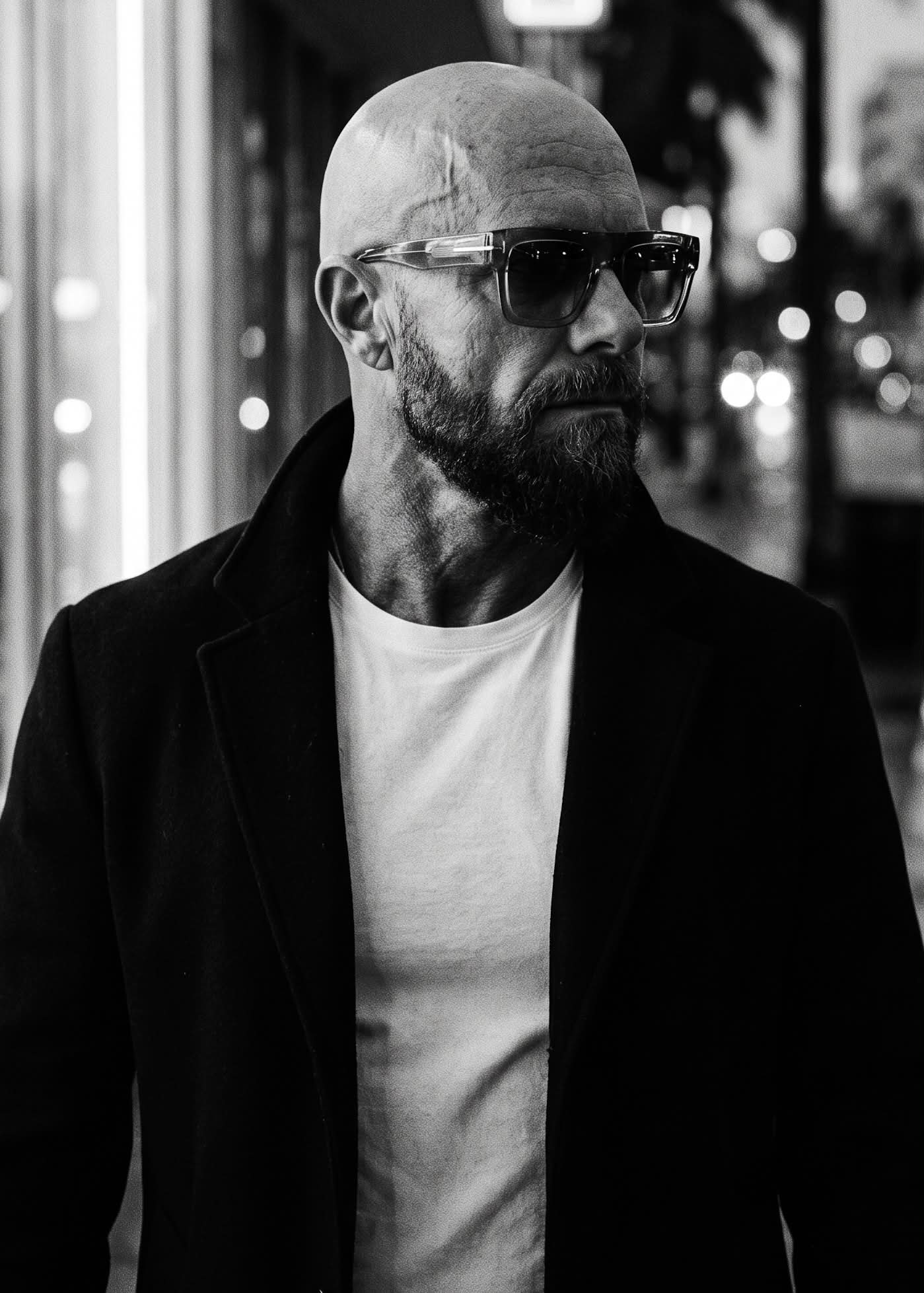
There is a man on television explaining where we come from.
He does it calmly, with the easy kindness that comes from being right without ever having to prove it, and he explains that the Denmark we know came into being sometime in the sixties, in a collaboration between enlightened politicians, clever experts and an institution that took it upon itself to gather the people around a shared understanding of themselves.
He is not lying. It is worse. He believes it, because he has himself been down in the archive looking at the old broadcasts - and there is nothing in the archive from before the archive, and therefore there is nothing of relevance before the archive.
But let us go down beneath the studio floor. Not to 1950. All the way down. Down to the bedrock, and then walk back up together, layer by layer, and see what actually stands on top of what.
At the bottom of the Western world, to which Denmark belongs, lies a claim. It is made in an occupied backwater province of the Roman Empire, by people without power, without an army, without anything at all, and the claim is this -
That every single human being bears the image of God. Not the emperor. Not the citizen. Not the free man. Every single human being. The slave. The woman. The child. Even the unwanted infant, which the Romans quite legally and quite normally laid out on the rubbish heap, if it was a girl, or sickly, or simply in the way.
One must understand how insane that claim was. The Roman world was not evil by its own measure. It was well-functioning. It had law, roads, aqueducts and a clear order, where a human being's worth followed from its status, and that order was not a problem waiting to be solved, because no one could see it from the outside. It was Reality. And it was all of Reality. There existed no other place to stand.
Until there came a place to stand.
The first Christians began to pick up the abandoned infants. Not because a law commanded them to, there was no law, the law was on the rubbish heap's side. They did it because they had been given a measuring stick, and when they held the rubbish heap up against it, the conclusion could only be one - this cannot be right.
That is, as far as I can see, the first time that sentence is said in our history, and it has not been silent since.
Paul later wrote that there is no difference between Jew and Greek, slave and free, man and woman. He probably had no idea what he had ignited. It was a fuse two thousand years long, and it is still burning, and every layer in what follows is a place where it reached something flammable.
Five hundred years later, monks sit in Benedict's monasteries and work with their hands, and that does not sound like much, but in the ancient world physical labour was slave labour, something a free man was ashamed of.
The monks prayed and dug and wrote and built, "ora et labora", and thereby work became holy, and the thought that there is dignity in doing one's work properly, the thought on which the entire Danish work ethic rests, was born in a monastery garden and thus not at an LO office, as the man on television with the kind face says between the lines.
In 826 Ansgar comes ashore. In 965 Harald has carved in stone at Jelling that he made the Danes Christian, and one can think what one will of Harald's motives - kings have historically seldom had pure ones - but the stone stands there, and it is not a memorial plaque, it is a birth certificate.
In 1241 the Jutlandic Law opens with the words that with law shall land be built, and the preamble is penned in the shadow of the church, and its real explosive force lies somewhere other than in the famous line - the law also binds the king.
Power is accountable to something above itself. That is not a Greek thought and not a Roman one, the Romans' emperor was himself god - no, it is the thought that there exists a Judge above the judge, and without that thought there exists no rule of law, only rules.
The monasteries become hospitals, Houses of the Holy Spirit, poor relief, the unthinkable becomes institution - that the sick and the poor and the mad are not waste but a task. The Church builds the universities, Bologna, Paris, Copenhagen in 1479, from the premise on which all science still lives without saying thank you - that the world is created by a reason, a Logos, and can therefore be explored, because there is something ordered to be found. That thought gave birth to a revolution that happened nowhere else, but which is the direct cause of you now sitting 550 years later, with a phone between your hands reading what I am writing right now.
No establishment of university, no science, no phone.
Then comes 1536, and the Reformation does something that no Danish textbook really dares say aloud - it places every single Dane in direct connection with the truth.
The Bible in Danish.
Every man his own reader of God's word. The ordinary person's conscience becomes an authority that no bishop and no king can interfere with, and from that moment it is only a matter of time before a people of consciences begins to ask questions.
Confirmation in 1736 requires that children can read, and suddenly a poor peasant country in Northern Europe can do something the great powers cannot - almost everyone can read. And think about what it was they read. It was not a tribute to the king, not a law book, but a book where God chooses shepherds over princes and says that he makes no distinction between people. Absolute monarchy taught its people to read in a book that undermines every absolute monarchy.
And then the clockwork really starts striking, so hold on here, even though I am only just scratching the surface -
1788. This cannot be right - that a man is bound to the estate where he was born, as if he were soil and not human. Stavnsbåndet falls.
1792. This cannot be right - that people are sailed across a sea as cargo. We cannot believe that Man is created in God's image and simultaneously enslave him. Denmark decides as the first country in the world to forbid the slave trade. The ordinance only took effect in 1803, and slavery itself persisted in the colonies all the way until 1848, and the money smelled good all the way. The measuring stick does not acquit us. It also judged us, and that it could judge us, that there existed preachers and writers who held Denmark up against it and found Denmark wanting, that is the very proof that it was real. A measuring stick that only measures others is not a measuring stick. It is a weapon.
1814. This cannot be right - that a child of God's image grows up unable to read. Compulsory schooling for all, under an absolute monarch, in a country that had just lost its fleet and state bankruptcy was at the door. They found means for it anyway. That says something about what they thought was important.
1844, Rødding, the first folk high school, Grundtvig's conviction that a human being must be awakened and not filled.
1849, a constitution that is given rather than fought for, with freedom of religion written in by a Christian majority, for faith that is forced is no faith, Luther had said that three hundred years earlier.
1882, Hjedding, farmers who own a dairy together, because they have sat in assembly house and church together and know that a word is a Word.
1899, the September Settlement, two parties with no law above them, only the Word.
1915, and the fuse from Paul reaches another layer - slave and free, man and woman. This cannot be right, that half of God's images may not vote.
And then October 1943. The bishops' pastoral letter is read from the pulpits, in the middle of the occupation, with power listening - the church protests against the persecution of Jews, for it conflicts with the sense of justice that lives in the Danish people, and with our understanding of what a Human Being is. And then fishermen sail back and forth across the Sound for weeks with people in the cargo hold, this time to make them free, and most of them could not have formulated a theological justification if you had asked, and that is precisely the point.
The measuring stick no longer sat in the books. It sat in the spine. When law and conscience parted, an entire people knew without hesitation which of the two stood highest, and that knowledge was not invented in 1943. It was inherited through every single one of the layers we have just walked up through.
Seventeen years later, the Man on Television turns on the light in the studio.
He inherits it all.
The trust, the literacy, the work ethic, the sense of justice, the word-keeping, the entire long column of this cannot be right, and he calls it "Danish values", and he dates it to his own youth, and he does it without malice, for one cannot remember a birth one was not present at.
But see what is lost in translation. Every single layer in the column came into being because someone held reality up against something that stood above reality, and found reality wanting.
The slave became free because there was a measuring stick. The child went to school because there was a measuring stick. The Jews came across the sound because there was a measuring stick. That is the equation all the way down through history since a young carpenter decided to tell the Truth even if it cost him his life.
Remove the measuring stick, and all these things do not become evil, they become something worse, they become arbitrary. Things we are accustomed to. Things from the sixties. Things one can take a position on.
A people can live for a long time on an inherited spine. But only as long as no one asks it to prove why the spine is right.
The man on television is still sitting there. He is still kind, and he is still certain, and he is still explaining where we come from, and he still begins in the sixties. And one cannot even really be angry at him, for he is only showing us the archive, and the archive begins where the camera begins.
But beneath the studio floor stands the column, layer upon layer upon layer, two thousand years of "this cannot be right", and it carries him while he speaks. It carries his freedom of speech, his trust that no one will storm the studio, his certainty that he has value, even when he is wrong.
He stands on it. He just does not, apparently, know it.
But without the measuring stick, all distances are equally valid. And everything therefore indifferent.
One can certainly broadcast for many years yet on an inheritance one does not know one has received. One just cannot pass it on.
And some of you, especially those who are older, probably sense that it has begun to slip.
❤️🔥🪽
Good Saturday, friends ☀️