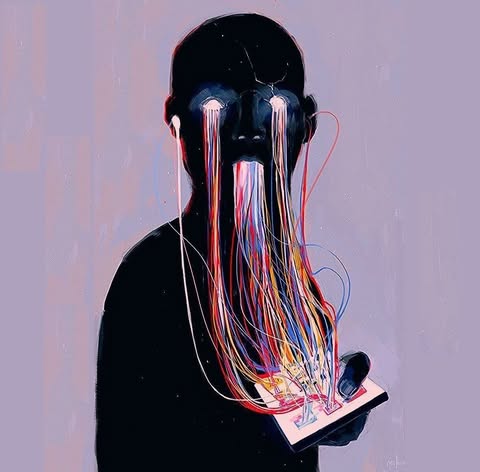
We live in the age of conspiracies.
It has become a mark of our time that theories about hidden agendas, secret networks and invisible powers flourish like never before.
But it's too easy just to point fingers and dismiss it as madness. Because it's not that people have suddenly become more insane or more naive than before - ok, some have absolutely lost the plot - but because the mechanisms of society itself are driving us there.
It begins with language.
In just a few years, words like tinfoil hat, conspiracy theorist and other terms and labels have become a fixed part of our vocabulary. They're not used as neutral designations, but as stamps. They are a modern version of the Middle Ages' "heretic" - words that don't answer a question, but close it.
And so something happens to curiosity.
When people know in advance that any critical question will be met with mockery, they choose silence over openness. And in the silence, distrust grows. Because man can live without much - but NOT without meaning. And if one isn't allowed to investigate, one seeks explanations elsewhere.
This applies almost regardless of the subject.
Try asking whether the handling of corona was proportional, or whether the vaccines were tested thoroughly enough. You're immediately stamped as an anti-vaxxer.
Wonder whether gender in sport and biology still has significance, and you immediately risk being called transphobic.
Consider the consequences of large-scale migration for culture, economy and security - and you're met with the word racist.
Talk about climate, and if you mention nuclear power, or if you doubt that the green transition is as "green" as it's claimed to be, you get the stamp climate denier.
Ask about wars, about Ukraine, about NATO, about Israel and Palestine - and you're made into a propagandist or extremist.
And worst of all.
Mention the name Trump. Not even to support him, merely to analyse his politics soberly - and immediately you're placed outside. Fascist. Authoritarian. Democracy's enemy. His name has been made into a kind of political primal evil, which no one may touch. But precisely for that reason he's a perfect example of how sick language has become - we no longer discuss ideas, we merely condemn by association.
Instead of investigating things together, we use language to shut each other down.
Just look at the comment threads today. It takes seventeen seconds before a conversation degenerates into f*cking Ragnarok - old quarrels, locked-in fronts and automatic responses that repeat themselves on the back of hundreds of previous threads with other people are pulled down over the view and the keyboard. People call each other the most vile things - without listening. The conversation disappears, and what remains is only the reflex, not the exchange.
But the mechanism isn't new. We know it from history. The Soviet Union called critics "enemies of the people." During McCarthyism in America, dissenters were stamped as "communist sympathisers." In the Middle Ages it was enough to be called "heretic" to have one's life destroyed. Or ended. Everywhere the logic is the same - When power cannot or will not answer questions, it resorts to language as weapon.
I grew up in a time when I believed we had definitively left that mechanism behind us - but overlooked that Man is Man - so therefore it will always be here. And this time - with a vengeance.
The psychology behind it is simple. When one loses trust in the official explanation, one seeks another. Not because people love the improbable, but because we cannot live in a vacuum -
We MUST understand what's happening, otherwise our world falls apart.
And it's important to understand - because it's not the conspiracies themselves that are the greatest problem of our time. It's the culture that pushes people there - a culture where curiosity has become dangerous, and questions are confused with crimes.
Here also lies fate's irony and misfortune -
The more one attempts to suppress questions, the more distrust one creates. The harder one stamps down a thought, the stronger it gains life. The more one tries to suffocate the fear of conspiracies, the more they explode.
Everyone must try to understand -
The system itself produces what it attempts to combat.
And the consequence is unfortunately not merely personal. It's democratic. Because without the right to wonder, without the courage to ask questions, without the possibility of testing ideas without fear of condemnation - there disappears the very foundation of a free society.
If there MAY exist only ONE truth, we no longer have a democracy, but a regime where power itself defines what is real.
So the question really isn't whether conspiracy theories are wrong. Many are, without doubt.
The question is what it does to us when we lose the ability to speak freely together. When we become afraid to be curious. And when we accept that labels and ridicule can replace arguments.
Perhaps the greatest conspiracy of our time isn't the many stories about hidden agendas.
Perhaps the greatest conspiracy is that we've forgotten that curiosity is the very lifeblood of a free society.
❤️🔥🪽