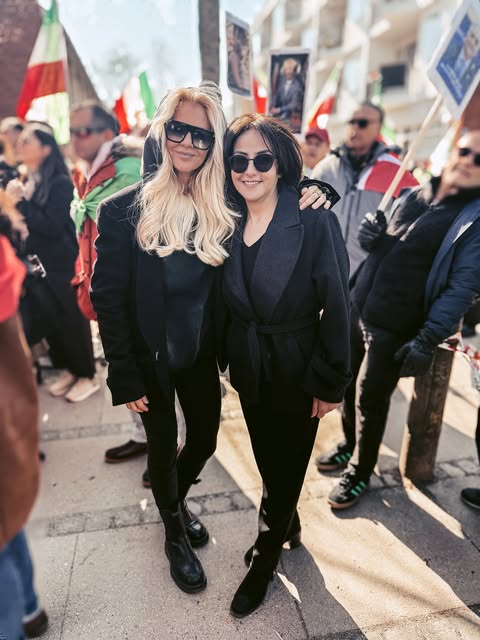
We passed the American embassy yesterday afternoon to show sympathy and support for the many Iranians who had turned up for a demonstration running simultaneously in many countries across the Free World.
Several have written to us in recent weeks, grateful for what we have shared, and in return shared their own stories with us.
They are stories about what happens to a society when Islam takes it over. Not Islamic individuals - it's not about them. But Islam as a political and civilisational system, with its own logic, its own phases, and its own end goal.
What they recount, I'm trying to gather below so it's comprehensible to everyone - even well-meaning politicians - because most of it sounds like a warning. A warning to the Western European person and society that has been lulled into civilisational sleep, and which doesn't yet see that the fate of the Iranians lies much closer to their own than they imagine.
When the Iranians tell about what happened in their country, there's something that recurs in almost all accounts. Not the details - those vary. But the structure of what and how it happened. That is the same.
And it has phases.
PHASE 1: Arrival
First there is nothing to see. People arrive, settle down, live their lives. They are discreet, hardworking, unproblematic. One would feel hysterical expressing concern. And perhaps that's precisely the point.
.
PHASE 2: Infrastructure
Then the institutions begin to arrive. Assembly places. Schools. Organisations with reassuring names. It's presented as religious freedom - and it is that too, in a way. But it's not only that.
A mosque is not just a place of prayer. It is an organisational centre, a legal advisory office, a political mobilisation point and a social control system in one. It defines who belongs to the community and who doesn't. It establishes norms for marriage, upbringing, gender roles and the relationship to the surrounding society - not as guidance, but as obligation. Islamic free schools are not just schools. They are generation-shaping institutions that ensure the next generation is not assimilated, but consolidated. And the many charity and lobby organisations with their neutral names and friendly faces are not just civil society. They are the political layer that translates demographic weight into institutional influence.
All of this is infrastructure. And infrastructure is never neutral. It is always for something.
.
PHASE 3: Demands and immunisation
Next follow the demands - first modest, almost reasonable. Special considerations here, exceptions there. Most think "Well, what does it cost me to grant them that". And simultaneously the slightly mystical - and for some disturbing - fact that anyone who questions them quickly discovers there's already a language ready to shut the conversation down. That language didn't arise by itself. It is also infrastructure.
The mechanisms are well-known, once you've seen them. The accusation of xenophobia that cuts off any factual conversation. The selective offence activated precisely when it's useful. The threat of violence that's never officially endorsed but never officially condemned either - and which nonetheless controls what can be said, drawn, printed, performed. And behind it all - the gradual norm shift, where the unthinkable becomes debatable, the debatable becomes accepted, and the acceptable becomes norm - without anyone ever sitting down and deciding it.
.
PHASE 4: Two cultures in one society
At some point there are two cultures in the same society. Two sets of norms. Two ways of understanding what a human being is, what a woman is, what the law is for. The Iranians know this condition from within. They describe precisely this.
"One lived one life at home and another on the street. Not because one chose it. But because it was the only way to survive."
To survive...
This is where people usually think it stops. That the parallel culture is the endpoint - something unpleasant, but manageable. Something one can live with. And many believe that, because that's precisely what they've been told. By their politicians. By the Man on Television. That it would work out, if only they were inclusive enough, open enough, accommodating enough. That diversity in itself was a guarantee. That the only thing that could go wrong was intolerance.
But it's not the endpoint. It's the preparation.
.
PHASE 5: Seizure of power and what gets overwritten
What came after in Iran came quickly. Those who had supported the movement - leftist intellectuals, feminists, nationalists - several of the same conscience-disturbed groups we see at home - were the first to be purged. Up against a wall. Thanks for the help, we don't need you anymore.
The coalition with them was a means.
But it had never been a goal.
.
PHASE 6: Cultural revolution and norm overthrow
In Iran's case. The universities closed for three years. Humanities subjects - law, sociology, psychology, economics - were rewritten. Music forbidden. Sexes separated. Women's legal status set back to 7th century standard. Street names arabised. It didn't happen slowly. It happened in months, because the foundation had been laid over decades.
.
PHASE 7: Civilisational replacement
The most painful thing the Iranians in exile tell about is not the loss of freedom, though that is enormous. It's something else. It's the attempt to erase Persia itself. The 2,500-year-old civilisation with Cyrus, Zoroaster, Hafez - systematically arabised. Street names. Language. Calendar. History.
Because it's not politics.
It's civilisational replacement.
In Europe we don't yet know what phases 5, 6 and 7 look like. But we know what there is to lose. The same as the Iranians lost - just with different names. Not Hafez and Zoroaster, but Grundtvig and Luther. Not the Persian mosaics, but the Romanesque churches. Not Nowruz, but Christmas. Not Tehran's secular universities from the 1960s, but the intellectual freedom that made them possible - the right to doubt, to mock, to draw, to leave one's ancestral faith without it costing one's life. The right to seek freedom outside a closed book that gives it. That freedom which didn't arise by itself, but has been fought for over centuries and rests on a particular view of humanity - a view not shared by what is moving in.
.
The interesting thing is not that it happened. It's that it followed a pattern which was readable all the way through - for those who wanted to see.
That pattern is 1,400 years old. It has not changed. Not because it hasn't had time. But because in its own logic it CANNOT change. It is not a cultural tradition that develops in meeting with others. It is a totalitarian thought system with built-in immunity AGAINST change - and with a very precise internal consequence for those who attempt it.
European politicians think they are in dialogue. That they're negotiating. That somewhere out there waits a compromise that can satisfy both parties and preserve what's essential. It's an understandable mistake - because that's how Europeans themselves think. One projects one's own mentality onto the counterpart and assumes that everyone fundamentally wants the same thing - a reasonable result, no one wins completely, no one loses completely.
But that presupposes the counterpart thinks the same.
We know from the twentieth century that the human brain doesn't necessarily do that. The Totalitarian Mind - that mindset willing to sacrifice everything, including its own population, for an unnegotiable truth - cost the world over a hundred million human lives in the last century. We know this. We've written the books. Built the memorials. And yet we install again and again the notion that everyone deep down wants the same as us.
They don't.
It need not surprise anyone.
It can only surprise those who have decided not to look.
Iran is the clearest example because it happened compressed and within living people's memory. But the pattern is the same everywhere it has happened - Egypt, Syria, North Africa, Anatolia - only in slower tempo.
The phases are not a theory.
They are a historical description.
And it's high time for the European person to wake from their sleep.
❤️🔥🪽
If you are an exiled Iranian you are very welcome to comment - if there's something I've forgotten or haven't included.
Just as the post is welcome to be shared and translated into whatever language you like.
In the picture - Krisztina and, to my surprise, a completely fluent Danish-speaking doctor from Iran who has been here for 10 years with his family. Lovely meeting. ❤