Everyone cheers these days for what is called "the European community", without it being explained very often what exactly is meant by that.
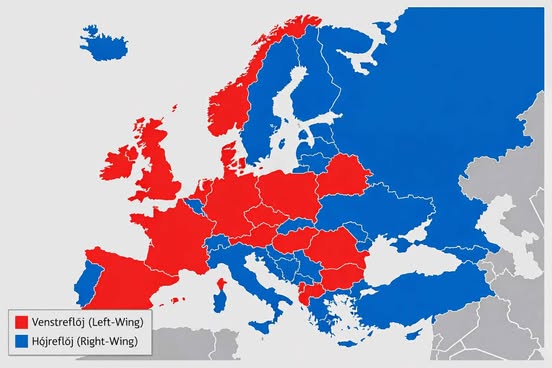
Here is the Europe actually being spoken of - as I understand it - drawn on a map with political governing power marked in colours, so it becomes easier to get an overview.
Below I have translated the set of ideas we are rapidly moving deeper into, into ordinary words, so the real consequences become easier to understand for more people.
Then anyone can decide for themselves whether this actually aligns with their inner conception of "the Western world" - or whether the "European community" has become something else.
What follows is therefore not a claim about evil or bad intentions, but a description of the direction the collective political choices point towards - and the consequences that follow from them.
...
DEMOGRAPHIC AND CULTURAL TRANSFORMATION
Europe is undergoing in these years a profound change in its population composition and cultural structure. Immigration from non-Western societies continues at a pace that places persistent pressure on welfare, housing markets, schools and local communities, while Islam gains an increasingly visible and normative place in the public space. This development happens without a clear popular mandate and without a shared narrative about how different value foundations should coexist in the longer term.
.
IDENTITY POLITICS AND DISSOLUTION OF COMMON NORMS
Where the individual was previously the starting point for rights and responsibility, society is increasingly organised around group identities. Gender, ethnicity and sexuality are made into political categories, biological realities are dissolved in legislation and education, and equality before the law is gradually replaced by special considerations and quotas. It creates a society where common norms fragment, and where differential treatment is legitimised in the name of equality.
.
MORALISATION AS POLITICAL GOVERNANCE
Instead of open debate and clear priorities, society is increasingly governed through morality. DEI and ESG requirements, politically defined dietary advice and symbolic policy initiatives are presented as necessary and unavoidable, even when the effect is limited or absent. The state and its institutions assume the role of moral authority and define what is responsible, acceptable and right - not only legally, but also ethically. Or... you know... "ethically".
.
CLIMATE POLICY AS OVERARCHING GOVERNING PRINCIPLE
Climate policy has increasingly become the framework within which almost all other policy is legitimised. So-called "decarbonisation" is no longer treated as a technical or energy question, but as a moral imperative that stands above economy, competitiveness, security of supply and national concerns. The result is that stable and cheap energy is phased out faster than real alternatives can carry the system, while industry, agriculture and transport are burdened with costs that none of Europe's global competitors assume to the same extent.
Europe reduces its own emissions on paper, while production is moved to countries with lower environmental standards, higher coal consumption and less transparency. The actual global effect is limited, but the local consequences are concrete - higher energy prices, weakened industry, less strategic autonomy and increased dependence on imports. Climate goals are met in spreadsheets, while reality is outsourced.
When climate policy is simultaneously coupled with morality, identity and guilt, resistance becomes not a question of disagreement, but of character.
Thus the space closes where one could discuss tempo, technology, priorities and proportionality - and decarbonisation becomes a governance tool rather than a means.
The question is NOT whether climate challenges exist, but whether the chosen strategy actually reduces global emissions without simultaneously undermining Europe's economic, industrial and strategic viability.
.
CENTRALISATION OF POWER AND WEAKENING OF DEMOCRACY
Power moves gradually away from national parliaments and local decision-making spaces and over into supranational structures, courts, agencies and bureaucracies, which citizens cannot actually remove. Simultaneously a new elite bureaucratic and NGO class emerges, living off administering problems rather than solving them, and which is structurally, democratically and geographically separated from the consequences of their own decisions.
Common to many of these developments is that they cannot be reversed through ordinary national elections. They are embedded in supranational agreements, legal frameworks, regulatory systems and moral obligations, which lie outside direct democratic control.
Thus the course becomes stable, even when the composition of voters changes.
.
ECONOMIC WEAKENING AND SELF-CHOSEN DECLINE
Europe systematically dismantles its own competitive advantages. Stable and cheap energy is phased out without technological realism, agriculture is restricted, taxes are raised, and regulation increases. The result is lower productivity, fewer global companies, less innovation and a slow, structural economic decline, which is often referred to as... "transition"... but in practice is experienced as decline.
.
SURVEILLANCE, CONTROL AND NARROWING OF THE SPACE FOR FREEDOM
To handle the consequences of these developments, surveillance, data control and administrative regulation expand - sold as "safety and security".
Freedom of expression is not limited through direct bans, but through platform rules, employer pressure, financial exclusion and social shaming, which makes expressing dissenting views risky.
.
CIVILISATIONAL SELF-CONFIDENCE, POWER AND THE ABILITY TO ENDURE
In the end all these developments gather in one more fundamental crisis -
Europe's weakened belief in itself.
A civilisation is not only its ideals, its rights and its good intentions, but also its ability to protect them and carry them through time. Military strength, industrial capacity, energy supply and economic productivity are not in opposition to humanism - they are its precondition. Without them values become declarations, morality becomes empty rhetoric and community becomes administration.
Europe has for decades deprioritised both defence will and industrial sovereignty. Real military capacities, preparedness, ammunition and weapons production have been hollowed out, while strategic supply chains, energy production and key technological industry have been moved out or regulated away. The result is a continent that expects security without power, welfare without production and strategic autonomy without its own muscles - and which is increasingly deeply dependent on others for its protection, its energy, its raw materials and its freedom of action.
When this material weakening is accompanied by cultural doubt in itself, historiclessness and suspicion of its own heritage, a society emerges that still speaks in high ideals, but acts with steadily less force. A Europe that administers its own decline with great moral self-assurance, but low realism, in a world where power, production and coherence matter again.
...
That is - in rough outline - what the map illustrates, when one translates "the European community" from PowerPoint language to reality language - and as a political direction with entirely concrete consequences.
Large parts of it are simultaneously why the world's superpowers - USA, China, Russia and soon UAE - no longer count the EU as a player on the field.
A community that can no longer protect itself, feed itself or make decisions close to its citizens does not become more solidary - but more dependent.
Are we on the right course - and is the above the 'European Dream' you hoped we would live inside in this century?
Good evening. 💫