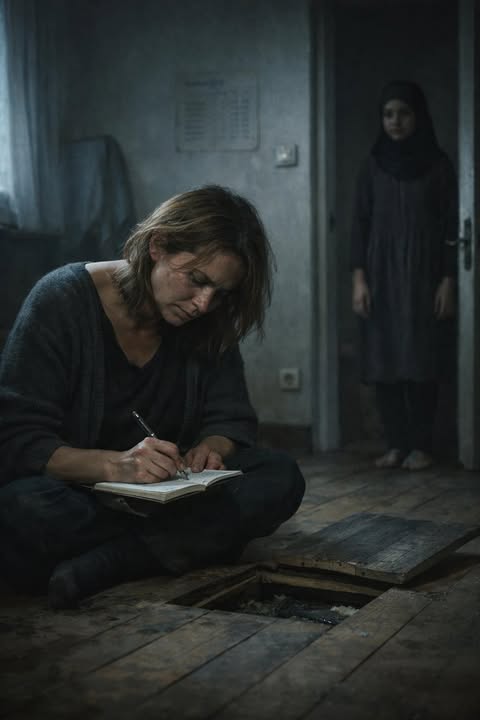
What follows is a letter from a Danish woman in Denmark's future.
Is it 2060? Or 2080? 2100?
We don't know for certain.
Does the exact date matter?
Yesterday I described the phases Iranians recognised from their own country when the full Islamic doctrine took over. That structure which is not a theory but a historical description - and which follows the same logic everywhere it has unfolded - because it cannot do otherwise. It is not negotiable and it is not open to interpretation. It is built to be precisely what it is - and what it does. A superstructure.
I have received several messages. From Iranians in exile who nod in recognition. From others who share their own accounts - about what happens to a society when the phases advance. Not what they fear. But what they have seen and experienced.
What I write below is not fiction. Nor is it journalism. It is something in between - a voice composed of the stories I have been entrusted with, placed into a Danish context and future that none of us want, but which the phases point toward if the course is not broken.
I mean no ill toward the individual Muslim. I repeat that because it is true, and because the distinction is crucial - this is not about people and their faith. It is about a complete civilisational system with an internal architecture that consistently produces the same end result - because it is constructed to deliver this.
Enjoy. I think.
…
"…I no longer know what date it is.
I learned to stop thinking about that many years ago - the days don't have the same shape anymore, they don't have that rhythm they once had, when Monday was something different from Friday, when weekend meant something, when time belonged to oneself in a degree one never gave thanks for. Now the days are just what lies between the prayers. Five times. And one learns to arrange oneself. One learns it... because the alternative is something one does not wish to think about.
My mother could never have imagined this. How it is here now… Not because she was naive - she was not naive, she was a doctor, she had seen people suffer and die and she knew life's hardness - but because what has happened resembles nothing she had language for.
Denmark was a fact to her. Freedom. It was not something she considered or thought about. It was like gravity. Like the sun rising. That it could become as it is now - that I would one day sit here and write these words in a notebook I hide under the floorboards, because no one must know I write - that was beyond the possible.
I hide it under the floorboards… It is important to understand what that sentence means. That there are words one must not have now.. that thoughts can be illegal. That I am afraid of my own handwriting.
Fatima from the third floor disappeared in February. No one said anything. That is the most frightening thing - not that she disappeared, but that no one said anything. Her husband still went down to shop in the morning. The children went to school. And the rest of us nodded to him in the stairwell and asked about nothing. Because we knew the question itself was dangerous. That curiosity is a form of participation, and participation is a form of guilt. We have all learned this logic now. It sits in the body.
I don't know what she had done… Perhaps nothing, in the sense we once used the word… Perhaps she had said something. Perhaps someone had heard her say something. Perhaps it was just a look - a look that lasted too long, a lack of sufficient submission at the right moment toward the right person. The system has no need for great crimes… it needs examples… and the examples keep everyone else going.
My daughter is called Sofie. She is fourteen now.
I have taught her to bow her neck… That is a sentence I wake from at night… that I have done it.. that it was me who taught her that… that my hands are the ones that have shaped her into what she is now becoming…
I remember the day she came home from school and asked me if it was true that Denmark had always been like this. Like it is now. She was ten years old. And I saw in her eyes that she already knew the answer she received was one she had to be careful with.
I said yes. I said yes to my own child.
I don't know what is worse - that she believed me.. or that she didn't, but chose to pretend… We resemble each other too much. I know that look. It is my own.
I dress her in the morning and make sure nothing is wrong. Not too much hair visible. Not too much of her face. Not too much of her youth, her life, her future. She must be respectable. Hidden away, so she doesn't stand out and someone sets eyes on her.
And while I do it, I sing inside a rage so old and so soundless that I no longer know if it is anger or just breathing. Something one does to survive. Something that keeps one alive without one knowing why.
There was a man in our street - Anders his name was, he had a bicycle shop - he refused to close during Friday prayer. Twice he received warnings. The third time they came. At night. We heard it. Everyone heard it. But no one went out.
I heard my husband breathing beside me in the darkness, and I knew he also lay awake, and we did not say a word to each other, because the words were too dangerous even between the two of us, even in our own bedroom, even in the darkness. We just lay there and heard it and waited for it to stop. And finally it stopped. And in the morning the bicycle shop was closed. And Anders was no longer there.
My husband got up and made coffee. I got up and woke Sofie. We sent her to school. Then we each went our own way.
That is what the system does, which no historian afterward will be able to describe precisely enough - it makes one continue. It makes one make coffee and wake one's child and go to work as if nothing has happened, as if what one heard in the night… was not what one knows it was, as if one is a whole person… and not something being emptied slowly and thoroughly and without leaving traces.
I was myself sixteen when I first saw a flogging in the square.
It was a woman. I didn't know her. She didn't scream - that surprised me most, that she didn't scream, and I have since thought much about it, whether it was courage or whether it was something that had broken in her long before. The crowd stood still. No one looked away - it was not permitted to look away - and I stood there with my fifteen years and my fourteen years and my thirteen years… all my years at once… all the years I once was, and something in me understood in that moment that the girl I had been no longer existed. That she had ceased to exist the second I didn't look away.
My mother stood beside me. I felt her hand that soundlessly found mine. She pressed it - not hard, just once, like a code we had never agreed upon but both understood. I am here. I know. We will survive this. Just be quiet.
She died three years later. An infection that didn't need to kill her, but which did, because she was a woman and the doctor was a man and there were rules for when she could be examined and by whom and under what conditions, and those rules cost her the three weeks that were the difference between life and death.
I think of her every day. Of the dress she wore on a Sunday we were in Fælledparken when I was small. Of her bare arms and her big light loose hair. She sat drinking wine with my father on the grass.. and the free high laughter she had, that started in her whole body. Of the person she was, before the world decided she should be something less…
Sofie asked me the other day if I was happy.
I don't know where she has that word from. We don't use it anymore - not because it is forbidden, but because it has stopped meaning something precise. Happy… I sat with it a moment and tried to remember what it was. Not happiness in the large sense - I haven't thought about that in years - but just the simple, bodily state of finding oneself in a good place in one's own life. To feel that one wants to be the place one is.
I told her I was.. grateful. That is the answer that is correct to give. Grateful for what we have. That we are healthy. That we have each other.
She nodded. She is fourteen and clever and she resembled me when I lied to her about Denmark.
At night I lay thinking about Fælledparken. About a Sunday I can barely remember anymore, because it is becoming too far away, too unreal, too much like something one has dreamed and not experienced. The grass. My father's laughter. They rolled around in the grass and kissed while we heard American rock music… and love songs loud on the portable speaker… free music… I cannot remember when I last heard it… the only music now is the state-approved… the self-evident, inexplicable, not-worth-mentioning freedom of being a human in a country that didn't ask one for permission… is gone…
Sofie has never seen it.
She doesn't know what she doesn't know.
That is what is hardest to bear.
Not what we have lost. But that she never knew there was something to lose…
Sometimes I am caught in worry and fear for her future. She has never asked me about love - not in the way I knew it, the unreserved, bodily, free way of talking about it, as if it were something one had a right to. She doesn't know it was once like that. That her grandmother met her husband at a garden party one summer evening, half-drunk and happy, and that no one asked for permission, and that no one needed to. Those patterns are gone now. Not forbidden to remember - just without reference. Like words in a language no one speaks anymore.
I look at her and try to imagine her children. That is what makes me most silent inside - not what she has lost, but what her children will never know they lack....
The freedom that is no longer inherited anywhere here, because it was not defended, because it was not named, because the people who sat with power and language and microphones chose to call it a prejudice.
I think of them often. Not with hatred - I no longer have strength for that - but with a cold, clear bitterness that does not dissipate. The politicians who knew... but stayed silent. The journalists who saw it and instead of describing it, turned everything they saw upside down and problematised the countrymen who tried to say something clearly. The professors who wrote the beautiful texts about diversity as strength, while the strength was being eaten from within.
They probably meant well... most of them - that is the most unbearable thing about it. They were not evil. They were blind from their own goodness, deaf from their own self-righteousness, and they did not pay the price themselves....
Sofie pays it. Her children pay it. All the generations that come after pay it, who were never told there was something to fight for, because the adults in the room decided the fight itself was the real problem.
What still confuses me when I try to reconstruct what happened… is the speed. Not that it happened - but that for so many years it almost didn't happen, and then suddenly it all happened at once…
For decades the change was imperceptible. A neighbourhood here. A school there. A norm that shifted so gradually that no single shift was large enough to properly notice. Changes in the supermarket.. in shops... One adapted to the new, and the new quickly became old, and then one adapted to the next… That's how it went for thirty years. And then, in what felt like months, something had broken through… and I stood there and could not understand that I hadn't seen it… That none of us had seen it… That we had all been looking directly at it for years without understanding what we were looking at.
I still don't quite believe it.. even though I lived it and sit here writing…
And while all that happened before our eyes, they held meetings… decade after decade of meetings, committees, working groups, integration plans, dialogue forums, reports that were written and placed in drawers and referenced in new reports… and then from the beginning. They debated in Parliament…. Parliament… imagine when we had that… as if the debate itself were an action.
As if talking about a pattern were the same as stopping it...
But the pattern grew while they talked. It did, because that is what it has always done. Because it is built to grow, regardless of what is said about it in meeting rooms and at hearings and in parliamentary inquiries.
One does not negotiate with something that cannot negotiate. One does not compromise with something that in its own logic regards compromise as treason... They perhaps didn't know it - or didn't want to know it - and so they continued to hold meetings while time ran out.
I remember we were told many times that the fight against it was a problem. Not once - many times, in many contexts, said by clever people with good intentions and long fine educations.
That Denmark was different. That we had a culture that was strong enough, open enough, democratic enough to absorb and change and integrate. That all that had happened in Iran, in Egypt, in Anatolia, in all the civilisations that now exist only as archaeology and memory in exile populations - that it could not happen here. That we had something they didn't have. That we had learned something they hadn't learned. That history would make an exception for us, because we understood it better than those who had gone before.
But I understand it now - and that is what makes it so hard to bear. Not that we lost. But that the Iranians said exactly the same thing. The Egyptians said exactly the same thing. All the people who have since ended in exile with their memories and their sorrow and their incomprehensible loss - they all said it could not happen to them. That they were different. That their civilisation was too strong, too deep, too alive to be overwritten...
None of them were wrong because they were stupid. They were wrong because it is humanity's deepest instinct to believe that what has happened other places happens other places. That the exception is us. That we are protected by our own self-understanding.
We were not.
We never have been...
There is one word we no longer use. It is not because it is actually forbidden. But because it has stopped pointing to something real.
Freedom.
Dannebrog still hangs in some places. But it has stopped being ours. It didn't happen by law - no one said officially it was over. It happened by other flags slowly arriving, and by it gradually costing something to raise it, and by those who raised it anyway gradually becoming those one did not want.. or could... be known by... And then one day it was just there - a piece of cloth from another time, that hung and reminded of something no one any longer dared say aloud they missed.
I write this here, in this notebook, under these floorboards, and I don't know if anyone will ever find it. I don't know if Sofie will find it. I don't know if she will be able to read it, if the language is still the same, if the words carry the same weight, if she even has a place inside her that recognises what I am trying to reach her with here..
But I write it anyway.
Because it was real. Because we were there. Because my mother had bare arms on a Sunday in May, and my father laughed, and no one asked us about anything at all, and it was not nothing.
It was an entire life.
And we gave it away.
Not in battle. Not under coercion. But in yielding, in silence, in the gradual decision to pretend nothing - made by people who called it tolerance, who called it openness, who called it the "right side of history"...
The history I live inside now has no right sides left.
It just has consequences.
I wish we could do it over.
I wish someone would do something.
But there is no one.
It is all of Europe now.
And the Americans abandoned us when we no longer wished to stand with them in the Fight for Freedom.
The fight for the Human…."
❤️🔥🪽
...
You are welcome to translate the text into any language. European or outside. And replace nation and markers with your own.
It is a universal pattern being described - which in its full unfolding has its own logic regardless of how the host nation looks or is arranged - and therefore concerns all people who still understand what Freedom is - and why it is essential for harmonising the Human's structure and nature.
..
"…In him was life, and the life was the light of men.
And the light shines in the darkness, and the darkness did not grasp it…"
- John 1:4-5.
Have a good week, friends ❤️☀️