A LITTLE MORE ABOUT FAITH
"Eight hundred men were given a choice:
Renounce your faith - or die."
People without firm convictions can almost never understand people who have them.
And people with deep convictions know how nearly impossible it is to get believers to abandon them.
That reality is absolutely decisive if one wants to understand conflicts between civilisations.
In the West we live in a time heavily marked by postmodern relativism - an idea that truth is fluid, values are negotiable, and that all worldviews are ultimately just different perspectives. And moreover - equally valid.
History, however, shows something else.
There exist belief systems where truth is not relative. Where faith is absolute. And where people are willing to die - or kill - for it.
If one does not understand that difference, one fundamentally does not understand Man - or the world.
Before we come to the present, consider the words of Ayatollah Khomeini in 1942 -
"Islam imposes on all adult men... to prepare themselves for the conquest of countries, so that Islam's commandments apply in all the world's countries... Islam says: Kill all the infidels, just as they would kill you all... All the good that exists, exists thanks to the sword and in the sword's shadow... The sword is the key to Paradise."
One can naturally disagree with the words. Both as a Muslim and as a believer in something else.
But one cannot ignore what they represent -
Faith that is absolute - and prepared to act on it.
History gives us many powerful examples of what such conviction looks like in reality.
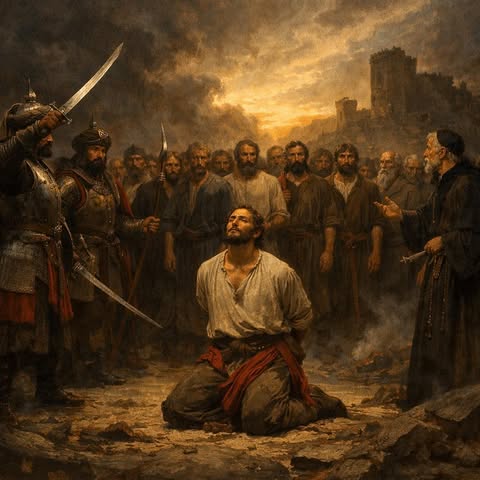
In 2013, Pope Francis canonised 'the Martyrs of Otranto' - eight hundred men who were killed in Southern Italy in 1480 after the Ottomans conquered the city.
Their story is almost forgotten today.
But it should not be.
When the Ottoman army took Otranto, the surviving male inhabitants - exhausted, beaten and starving - were placed before the Ottoman commander Gedik Ahmed Pasha.
They were given a single choice.
The classic one wherever the Ottomans advanced.
Convert to Islam - or die.
To persuade them, the pasha ordered an Italian apostate priest to preach to the prisoners and explain why they should renounce Christianity.
But a tailor named Antonio Primaldo stepped forward and spoke on behalf of the prisoners.
According to the chronicles, he said -
"My brothers, until today we have fought to defend our land and our lives.
Now the time has come to fight to save our souls for the Lord... since he died on the cross for us, it is fitting that we die for him, standing firm in the faith."
The prisoners answered in chorus -
They too were ready to die for Christ.
The next morning they were led through the city's smoking ruins to Minerva's hill outside Otranto.
Here they were executed one by one.
Primaldo was the first.
When the sword fell, the chronicles tell of something that made a deep impression on all present -
His body supposedly remained standing by itself after the beheading.
The executioners could not force it to the ground.
One of the executioners was so shaken by the sight that he converted to Christianity on the spot.
So he was naturally immediately executed himself...
The executions continued after that, until all eight hundred men were dead.
Think about that for a moment.
Eight hundred completely ordinary men.
Labourers.
Craftsmen.
Fathers.
They were given a single offer -
Renounce your faith - and live.
All eight hundred said no.
Massacres were not unusual in medieval wars - but Otranto was different.
These men were not executed for military resistance or for political rebellion. They were executed because they refused to convert.
Because their Faith was so strong that it made them impossible to frighten.
Their death took place just 27 years after the fall of Constantinople.
At that time, many in Europe feared that the Ottomans could continue further - into Italy and perhaps through all of Christendom.
The story of Otranto illustrates something that many modern commentators do not quite seem to understand -
Belief systems shape human actions in ways that diplomacy, incentives and political compromises cannot always change.
Today there are many who claim that criticism of Islam is merely ignorance or prejudice.
But the last 1,400 years of history show that the question is far more complex.
In 1829, John Quincy Adams wrote -
"The precept of the Koran is perpetual war against all who deny that Muhammad is the prophet of God... The command to spread the Muslim faith by the sword is always binding when it can be carried out."
And in 1899, Winston Churchill wrote:
"Mohammedanism is a militant and missionary faith... No stronger retrograde force exists in the world."
These statements may sound too controversially stark today. But they reflect a historical observation that recurs through centuries -
That Islam has often functioned not merely as a personal faith, but as a political and civilisational system.
For unlike many other religions - including our own Christianity - Islam combines theology, law and state power. The Koran is broadly understood as God's literal word - which makes profound revision or reinterpretation extremely difficult. If not impossible.
Even within Islam, different sects have fought violently throughout history over interpretation and authority. And lost.
The political power behind this system only truly declined after the fall of the Ottoman Empire. For centuries the empire had functioned as the dominant Islamic political power.
But in the 20th century, movements like the Muslim Brotherhood revived the idea that Islam is not just a religion - but a total social order that must regulate politics, law and culture.
In other words - the civilisational conflict (with the West) never disappeared.
And that brings us back to faith.
The men of Otranto believed so strongly in their faith that they chose death rather than renounce it.
The Ottoman soldiers who executed them believed just as strongly that they were carrying out a divine command.
When absolute faith meets absolute faith, compromise becomes almost impossible - and we know of only very few such conflicts that are resolved by negotiation alone.
They typically only end when one side loses the power - and/or the confidence - to enforce its vision of the world.
That is why moments like the fall of the Ottoman Empire are so decisive.
They mark the point in history where a political system built on a particular idea loses the ability to enforce it.
And such moments are often what determine entire epochs.
Not in the moment when the sword is raised.
But in the moment when a people no longer knows why it should even resist.
For it is not strength that first leaves a civilisation.
It is faith.
❤️🔥🪽
...
I actually have a two-year-old - unpublished episode - of the I Just Need to Understand podcast lying around, which over a couple of hours dives into this theme, which we have seen several times, also internally in Europe, over the last thousand years.
I'll see if I can find time to gather it and publish over the next few days - the podcast is resurrecting in English in The Word wrapping. 🔥