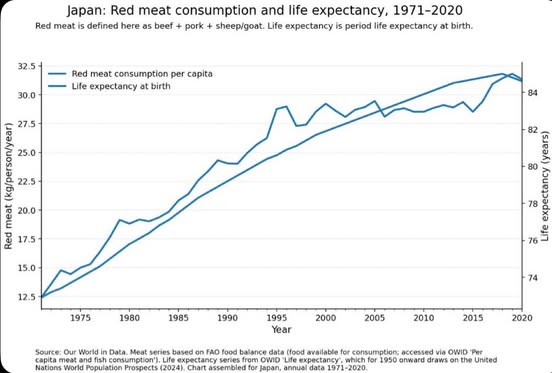
I find it so difficult to just let this obvious pattern pass.
Not because it necessarily overturns the entire understanding of health - or the programming they relentlessly subject you to - but because it touches something more fundamental, namely the relationship between what we're told, and what we can actually see, if we look without a filter.
By now we've had one particular story repeated so many times that it almost stands as a kind of background noise in consciousness - if the prices in the supermarket didn't scream it so clearly straight into your face.
Red meat is harmful. It should be limited. It's connected to disease and ultimately to lower life expectancy.
It's not communicated as an open question, but as something that appears settled.
And then you stand here in reality - where hundreds of thousands if not multimillions of people experience the exact opposite.
And here with a concrete example like Japan.
A country where the intake of red meat over a longer period has risen quite clearly. Not violently from one year to the next, but steadily, over time, in step with how society has developed. And parallel to that development you see something else that's also moving in one direction. Life expectancy. Upward. Stably. Markedly. Through decades.
It's naturally not perfect. It's not a laboratory experiment. There are a thousand other factors in play. Lifestyle, healthcare system, culture, genetics. We know all that.
But the question doesn't disappear for that reason.
Because how does that fit with the story we're presented with again and again?
If the connection between red meat and mortality was as clear and unambiguous as it's presented - as they nonstop try to massage in between your ears - then reality should at least pull in the same direction. It doesn't need to be perfect, but it should point roughly the same way.
It just doesn't here.
This isn't an argument that red meat is healthy in itself. It's not an attempt to flip the entire story around. It's something far simpler, and in reality far more uncomfortable.
That there's a crack between what we're asked to believe, and what we can observe. That they're lying. For some reason.
Because that crack isn't as easy to get around as one might wish.
If you - that's us - can no longer trust that the stories repeated with the greatest certainty are also the ones that best reflect reality, then you're left with something that requires a bit more of yourself.
Namely that you start to look.
Not to prove something in advance or win a discussion.
But to find out what's actually true.
And that's maybe the most interesting thing about all of it.
That the question is no longer whether red meat is good or bad.
But why the story about it is so certain, when reality isn't.
Because if I just stick to my own life, then it points in a direction that doesn't quite fit into the model we're presented with. Over the last ten years my meat intake has risen (markedly), and parallel to that something else has also happened. My health has gotten better. My vitality has increased. My surplus has grown. My sex drive, my life force, my appetite for life has moved in the same direction. At the same time my body fat percentage has fallen.
It's not a theory. It's not something I've read about. It's something I've lived.
And I'll admit most of my diet is cleaner of junk compared to the average, even though I'm not fanatical in any measurable way. I just eat what I experience is good for me.
So the question almost presents itself.
How does that fit together?
Why does that fit together?
Because there are by now many who can clearly see that there's something fundamentally skewed in the Western diet. Far too many calories. Foods of poor quality. A daily life with too little movement. And a systemic pressure on the body, where the insulin response is constantly being pushed out of balance. Which together makes it disease-promoting.
These aren't small things. These are fundamental things.
Yet it's as if the focus again and again gathers in one particular place.
Red meat!??
As if that's where the problem lies. As if that's the central factor that should be limited, regulated and ultimately perhaps phased out.
And this is where it becomes difficult not to ask the question.
Why exactly there?
Because if it's not the primary driver of what makes us sick, why is it the one that again and again gets pulled forward as the scapegoat?
Was it because it suddenly got woven into the climate debate?
Because it fit into a larger story about the green transition, where legumes and plant-based lifestyle aren't just a choice, but a moral direction you should move toward to "save the planet"? (read: buy The Story about a lot of products and solutions)
Maybe.
Maybe not.
What do I know.
But one thing remains.
When something gets repeated with the certainty we see here, while reality keeps delivering examples that don't quite fit, then it's no longer enough to just repeat the story.
Then you have to ask what it actually is you're being asked to believe.
And why.
Ask questions.
Because you don't really think the politicians have any useful answers - or that experts and industry are free from incentive to move us in a direction that's guided by truth over mammon - do you?
❤️🔥🪽