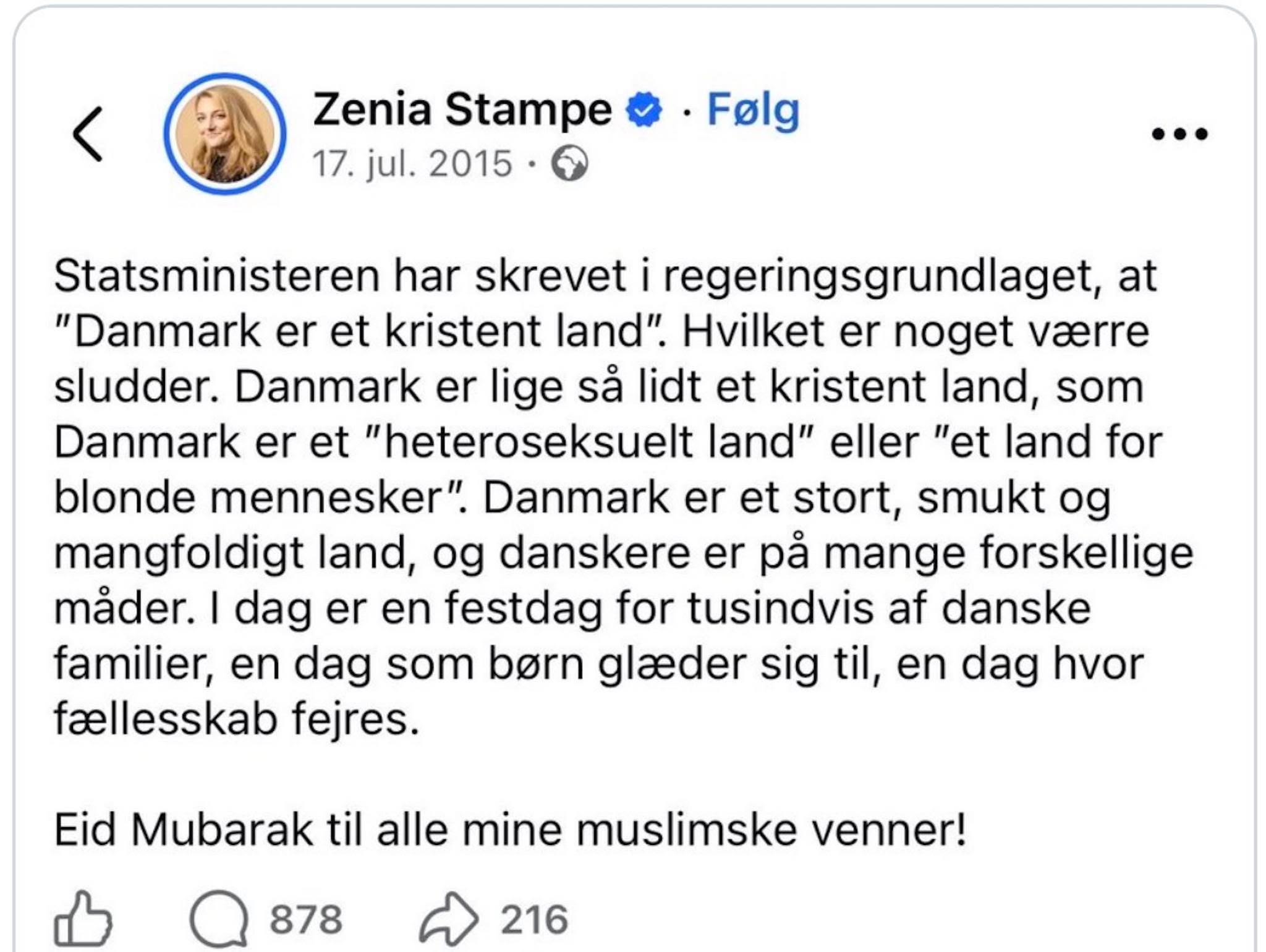
A nearly eleven-year-old post surfaced again today.
It was written on a summer day in 2015, on a holiday, just after a centre-right prime minister had written "Denmark is a Christian country" into his government platform.
A Radical MP reacted immediately. That was, she wrote, "utter nonsense. Denmark is no more a Christian country than it is a heterosexual country, or a country for blonde people."
And then she wished her Muslim friends a blessed Eid.
Notice what happens in those two sentences, because it is not an accidental error. It is the Error of the Age, stated cleanly.
It is a bit easier to see today than it was then, for many. But let me unfold it anyway, so everyone follows.
She lines up three things side by side, as if they were the same.
A Christian country.
A heterosexual country.
A country for blonde people.
It is hard to keep a straight face while I read it, and I am honestly sitting here smiling audibly as I write. Because that is quite a cocktail she is mixing. Skin colour, sexuality, and Christianity in the same glass, and the label on the bottle is unmistakable - the white man's patriarchal, racist religion. In one quiet gesture, the faith is moved into the box of things to be phased out, along with everything else a modern, enlightened person is best without. Whether she sees what she is doing or not. But let me hold onto that for a moment.
Because the last two on her list are tallies. They are about bodies, about how many have a particular inborn trait, and of course Denmark is none of those things, because a people has never looked like that. Ever. Anywhere.
The first, however, is something entirely different.
"Denmark is a Christian country" was never a census. No one ever meant that every single Dane kneels. Because it means something completely different - for instance, that the law, the week, the holidays, the language she writes in, and the very idea of the inviolable worth of the individual person, grew out of one particular tradition. A country can be Christian and full of unbelief at the same time, precisely as a house can rest on a foundation no one in the living room thinks about.
And it becomes visible in the way she concludes. She wishes her Muslim friends a joyful Eid. She knows perfectly well what makes a faith real. That it makes a day meaningful, that children look forward to it, that it binds people together. So she naturally grants religion all the dignity there is. But only to one tradition. And in the same breath denies her own country the right even to be mentioned. In other words, she can see the living faith in what she has not inherited, and only a meaningless label in what she has.
That reflex has a name. Oikophobia. The embarrassment at one's own and the infatuation with all that is foreign, made into a system and turned into a way of governing. It is a common feature on that side of the chamber, but it deserves its own post, so it will get one another day.
Because here we come to what this post is really about.
A faith does not survive because it once was there. A people's self-understanding does not persist by itself. It endures ONLY as long as each new generation understands it, carries it, and passes it on a little stronger than it was received.
And let us be honest here. The numbers have for years pointed to her being proved right. Twenty years ago, more than four out of five Danes were members of the national church. Today it is seven out of ten, and in Copenhagen barely half.
Fewer children are brought to baptism, and that decline is driven more by Danish parents who have stopped passing on baptism and faith than by those who have arrived from elsewhere. If the line continues, the day will come when Denmark, measured in her own way, is no longer a Christian country. She may well live to be proven right.
But that is precisely where the misunderstanding lies.
Because the day the believers have become too few to count, the foundation does not disappear with them. We still stand on it, or in its ruins, whether anyone in the living room still believes. Because the question was never how many kneel. It was whether we still understand what we have been given. What we have inherited. And no statistic can measure that. You only discover it the day it is gone.
So consider what a foundation actually is, because it is neither nostalgia nor decoration.
A foundation is what makes a people a people and not just humans who happen to live on the same piece of earth. It is the common ground beneath the words. When you and your neighbour say Freedom, Justice, Dignity, Human Being, the words mean the same to you, not because you have agreed on it, but because you have inherited the same deep story about what a human being is. It is that inheritance that allows you to speak meaningfully together at all, to disagree without going to war with each other, and to understand that a no means no, and that a promise binds.
Cut that thread, and the words remain standing, but they are emptied from within quite quickly. We keep saying Freedom and Right and Wrong, but we no longer mean the same thing, and we no longer have any common authority to turn to in order to decide who is right. You will stand before another human being, speak your own language, and slowly discover that you no longer share a world, a worldview, or an understanding of humanity and society. That the home may still stand, but is no longer a home.
It is not a freer people waiting on the other side when it has let go of its foundation. It is a people that has lost the ability to understand itself.
And that is worse than confusion.
Because where shared meaning disappears, language becomes power. And when no one can any longer say what freedom means, freedom comes to mean what the strongest decides it shall mean. Many have already experienced this form of linguistic capture in the past decade, where there are no longer any words to reach for in self-defence. Because the content of words has already been emptied and replaced with something new.
Regardless.
'In the beginning was the Word', says the tradition she calls nonsense, and it is not pious talk. It is the hardest sentence there is about a society. A people that loses the Word does not just lose a faith. It loses the ability to hold onto anything at all. And a void never remains empty. It is always filled. And never by the doubters, but by what is certain of itself and does not for a moment doubt what its own words mean.
A people that no longer knows what it means by freedom cannot defend it against anyone who knows exactly what they mean by submission. For instance.
And that is what her little post really is.
Not an attack on Christianity. But a testimony to what it sounds like when the thread is about to be cut.
She did not lie. I actually do not think she sees it.
And that is worse than the Lie.
The same woman who ten years ago called the inheritance a piece of nonsense, and who has been her party's spokesperson for both culture and church, became Denmark's Minister of Culture this week.
She called it nonsense...
Now she is appointed to guard it!
But she is not the danger. She merely said aloud what an entire people is forgetting. And if we lose the thread completely, we do not lose an old word in a document.
We lose the ability to understand each other, our country, and ourselves, while still holding the entire language in our hands.
❤️🔥🪽
Good evening, friends.
Anyone grilling? 🥩☀️