Maybe you've been to Knuthenborg. Or Givskud Lion Park. Or perhaps even been fortunate enough to have been on a real safari in Africa. Then you've most likely seen the signs with your own eyes.
Stay in the car. Keep your distance. Do not approach the animals. If you don't seek them out, they won't seek you out.
These are sensible rules. No one is offended by them. Because everyone understands the premise - you are visiting a territory that is not yours, among creatures you cannot negotiate with, and therefore it is you who must adapt. That's the whole idea of a reserve. The animals have the space. You have the road through it as a guest.
I found myself thinking about that advice when I read what the mayor of Høje-Taastrup said about his own main street -
"You can certainly come to the main street and feel safe, as long as you don't approach them. If you don't seek out these people, they won't seek you out."
That is not a mayor speaking.
That is a ranger.
And if that's how the municipality itself understands its main street, then let us take the consequence and get it down in writing, in the genre where the sentence actually belongs:
"Welcome to Taastrup Main Street Nature Park.
*The park offers a rich and varied wildlife, best experienced from a distance. We recommend that visitors move calmly through the terrain without seeking contact, as the population is generally not intrusive unless provoked.
*The visitor centre is located in the old library, where staff are happy to tell you about the area's development. Please note that the feeding ground in the alley between the kiosk and library can be particularly active in the morning hours. Trade at the feeding ground should not be disturbed.
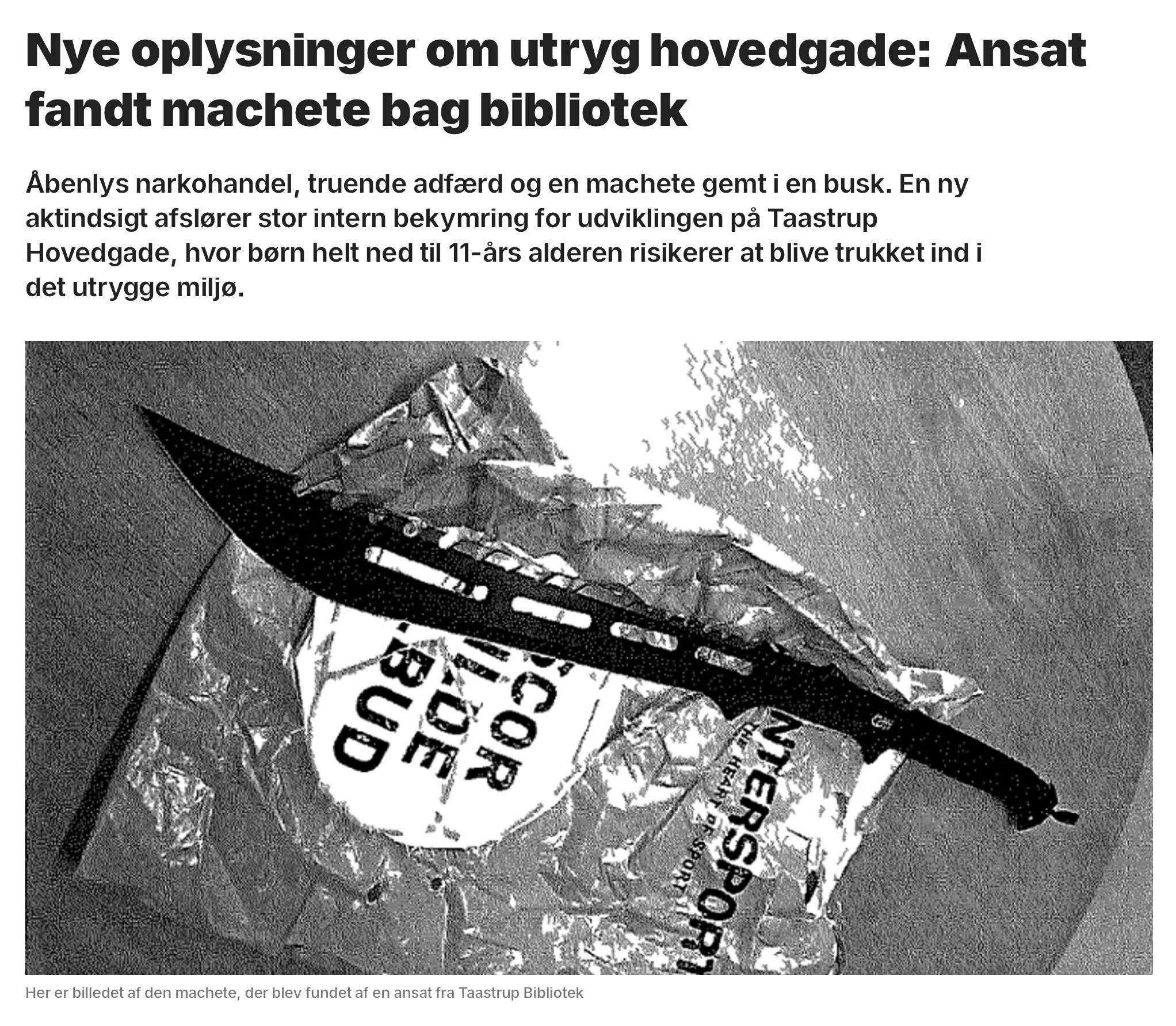
*Abandoned items in the shrubbery, including machetes, should be reported to park management but not touched. The find will be reported, and distance will be taken.
*Flocking behaviour, such as that observed on 10 July, is a natural part of the park's ecosystem and should be viewed from a safe distance. The season has otherwise been relatively calm.
*The park's youngest cohorts, from age 11 and up, participate in a mentoring programme with the older individuals. The programme is self-organising."
You laugh. For a while.
Then you notice what it is you're sitting there laughing at. Every single line in the little folder is documented reality from the municipality's own freedom of information disclosures. The drug dealing. The machete. The mass brawl. The children down to age 11 being drawn into the environment. The only thing I've changed here is the genre. And that's precisely what's unsettling - that reality could shift genre so seamlessly. That a Danish main street can be described as a reserve without a single factual detail needing correction.
Because a nature park is precisely the place where the logic holds together. There the advice makes sense. There it is right that guests should keep their distance, speak quietly and refrain from approaching, because the territory belongs to the animals, and the human is visiting.
But Taastrup Main Street is not a reserve.
It is a street in DENMARK, where people live, shop, borrow books and wait for the bus. And when the city's highest authority nevertheless speaks to citizens the way a ranger speaks to tourists, then something has happened that no one has put into words -
The territory has changed owner.
Not formally. Not by any decision. Just in practice, metre by metre, until the advice that should be directed at those creating the insecurity is instead directed at those being subjected to it.
And now listen to what is said when it all comes out anyway. The machete - "of course completely unacceptable". The negative behaviour - "completely unacceptable". Twice in the same article the mayor uses that word about a condition his own administration has followed for over a year while it grew.
And notice what the word has come to mean.
"Unacceptable" has become what you say when you have accepted something. It is not a judgement that triggers action. It is a formula that replaces it. You "take distance" because distance is free, and meanwhile the machete lies in the bush, the trade continues at the feeding ground, and a man responsible for it all assures us that the summer has been "relatively calm" - apart from the mass brawl, of course.
This is what a society sounds like that has stopped defending its own space and begun administering the loss of it instead.
And the direction is visible.
Because if the advice today is that you simply "shouldn't approach them", then we can already write next year's friendly suggestion from the municipality -
That citizens moving about to shop a bit at Matas or find dinner at Kvickly could advantageously wear stab-proof vests. Not because there's cause for concern, of course. Just as good advice. A small precaution, like the bicycle helmet and reflective vest.
Because safety is generally good on the main street, and with the right equipment you don't need to notice that it isn't there at all.
And it will be said in exactly the same tone as today. Calmly. Caringly. Completely unacceptable, of course, that it's necessary. But necessary.
That's how the boundary moves. Never with a bang, always with good advice. First you shouldn't approach them. Then you shouldn't linger. Finally you just need to remember the vest, and no one can any longer point to the moment when the street changed owner, because there was no moment.
There were only friendly suggestions from the Municipality Lady - one after another - each of them sensible, if you accept the previous one.
You make rules of conduct for guests.
Not for people in their own home.
You only do that in others'.
❤️🔥🪽
...
The post is a remix of my friend Jens Olaf Pepke Pedersen's - whom you should follow by the way if you suffer from climate anxiety. Better than both therapy and CO2 quotas, and unlike both of those it actually works. The only side effect may be that you start reading research articles in bed. So you've been warned.