It's been a long time since I made a post interpreting a passage from the Bible. And that's what I'd actually planned to do today.
But then I stumbled upon another beloved story I was reminded of through another post - one that, in the postwar era, for many, took over the Bible's role.
It's about Tolkien's Lord of the Rings.
And it's not just a feeling that it did that. That it partially took over. The book came out in 1954-55, but the real breakthrough didn't come until the mid-sixties, when the American paperback editions made it a phenomenon on campuses - 'Frodo Lives' was painted on walls, Tolkien societies formed, an entire generation took the book to themselves as something close to a shared myth. And notice the decade. It's the exact same decade when secularisation really picks up speed in the West - church attendance drops, religious education gets watered down, and it gradually becomes coded into the culture that you're a bit stupid if you believe in anything beyond what can be measured and weighed.
Two curves crossing each other in the sixties. One heading down, the other heading up. A generation put down one book and picked up another.
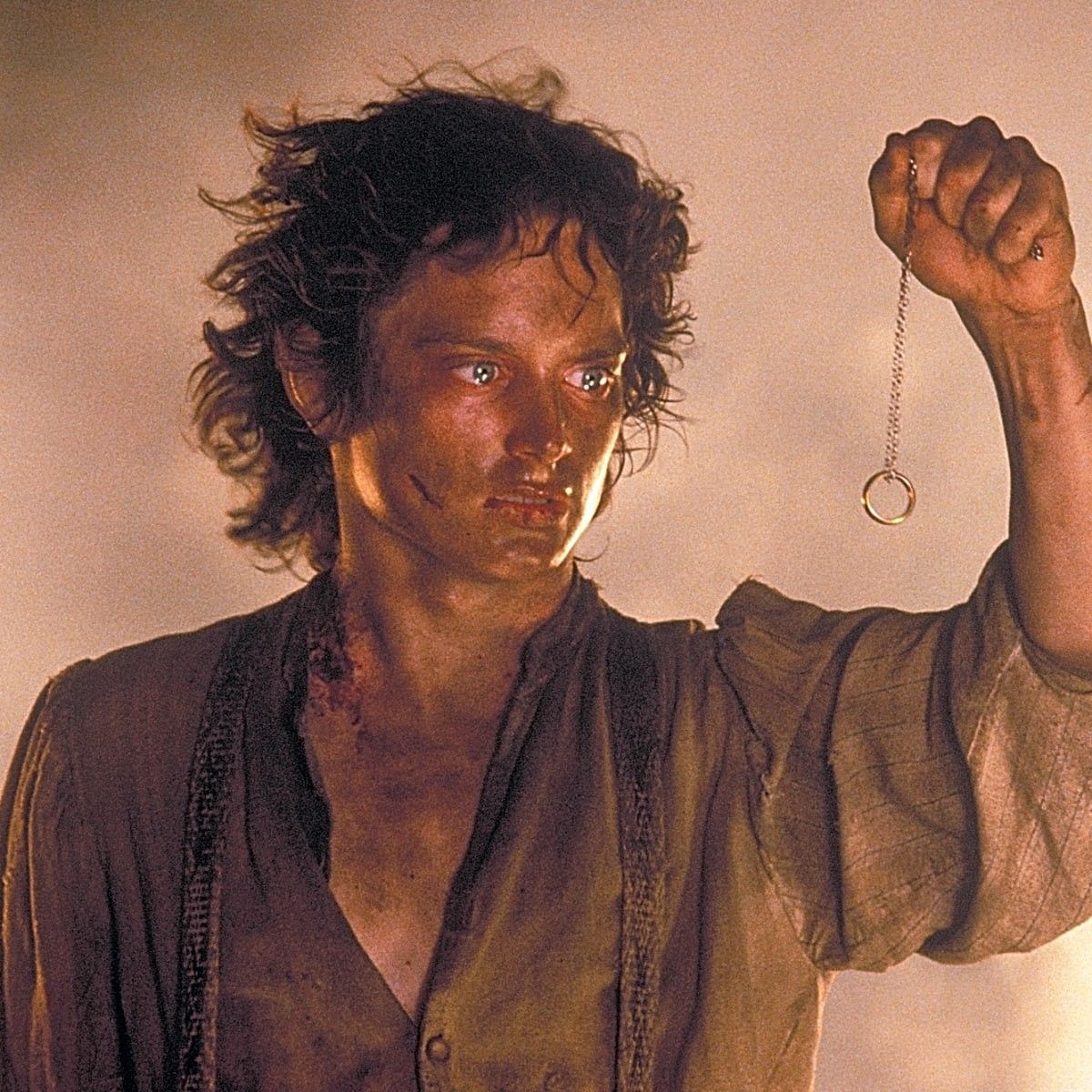
The scene I want to look lovingly at is the one on Mount Doom, where the Ring meets its end. I've heard it explained many times as if Frodo or Sam is the hero who completes the work. But Tolkien is so much deeper than that. And maybe it's easier to hear this when it's about a tale - than when it's about the great Story we ourselves live inside that I so often write about
So let's start at the Crack of Doom itself, because that's where Tolkien lays out his entire point - and it's the one most people miss.
Frodo reaches it. He has carried the Ring through everything, sacrificed everything, endured longer than any other being could have done - and then, standing at the edge of the fire, where the Ring's power is absolute because it's the place where it was made, he says no. He doesn't choose it away. He puts it on and claims it as his own.
Tolkien was completely explicit about this in his letters -
NO FREE WILL in Middle-earth could have cast the Ring into the fire voluntarily. Not Frodo, not Gandalf, not Galadriel.
Frodo's task was never to destroy the Ring - that was impossible.
His task was to carry it to the furthest point his Will could reach. And right there, where Man's strength gives out, something else takes over. Tolkien called it, in one of the letters, the Story's Author - and he didn't mean himself.
The second layer is Grace.
Notice that Gollum ONLY lives because he was spared three times. By Bilbo, who could have killed him in the darkness under the Misty Mountains. By Frodo, who blocked Faramir's archers. And by Sam on the mountainside itself, minutes before the end, where his hatred for Gollum gives way, because he suddenly sees what the Ring has done to him.
Gandalf actually says it already in the first book - something like "Bilbo's pity may yet rule the fate of many, and Gollum may still have a part to play".
Every single time Grace was strategically unwise. Every single time it was the bearing link. We all probably wondered the first time we read the book or watched the films. "Just kill him then!!" But it's not Strength that saves the world in Tolkien - it's three moments of Pity, which in the situation looked like Weakness.
And then the third layer -
Gollum is the only one who could take the Ring from Frodo there. Not because he's stronger, but because he's the only one whose desire is total.
Any free being would have claimed the Ring and kept it - and then Sauron would have won. Only one who is already completely consumed, who sees nothing else in the world but his Precious, could bite off the finger, dance blind with triumph on the edge of the abyss and fall.
And that's how it is. Here in Reality too. Evil destroys itself through its most devoted slave. It cannot create, only consume - and in the end it consumes its own project.
There's even an oath beneath it. Gollum swore by his Precious, and Frodo warned him that the oath would cast him into the fire himself, if he broke it. The curse fulfills itself.
The world is thus not saved by anyone's strategy. No one planned the outcome - not Gandalf, Elrond or Frodo. The Good outcome arises because Reality's moral order - Logos - works through human faithfulness and grace, not through their power.
And if you want to know what the scene illustrates and weighs, you can put names to the forces.
The Ring is the promise that Power can replace God - that control can take the place of trust (those inside Parliament should read that sentence a few times), and that Man can become his own master, if only he grasps hard enough.
Sauron is evil as it actually is - not a creative force, but a distorting one - it cannot produce anything, only possess and consume what others have built.
Frodo is Man - great enough to carry the burden, never great enough to save himself.
Sam is Faithfulness - the one who doesn't understand the whole plan, but keeps walking.
Gollum is what happens when Desire is made God - a Man reduced to his hunger. Grace is the three moments when someone chose to spare, even though wisdom and intellect said the opposite.
And the Story's Author - the one Tolkien mentions in the letters but never in the book - is Logos itself. The Order that carries everything, and which doesn't work through the grip of the strong, but through the endurance of the faithful and the foolishness of the merciful.
Salvation doesn't come because the hero is strong enough. It comes because Grace was given, long before anyone could see what it was meant for - and because Evil, which is a real force, when it's allowed to run its course, ends up eating itself.
And if anyone thinks this is something I'm laying over the text, Tolkien wrote it himself, in a letter to a Jesuit friend - that The Lord of the Rings is a fundamentally religious and Catholic work - first unconsciously, but consciously in revision.
He even explained why you can't see it - he had deliberately cut out almost all visible religion, because the religious element was absorbed into the story and symbolism itself.
And then Tolkien laid one last thing in the text, quietly, without pointing to it.
The Ring is destroyed on March 25.
Look it up in the appendices.
It's the old church date for the Annunciation - and for the Crucifixion.
The tale was never a replacement for the Story.
It was an echo of it.
And.
Let me postulate - that's why it hits you so deeply.
The Story of Stories will do that too.
If you read it the same way.
❤️🔥🪽