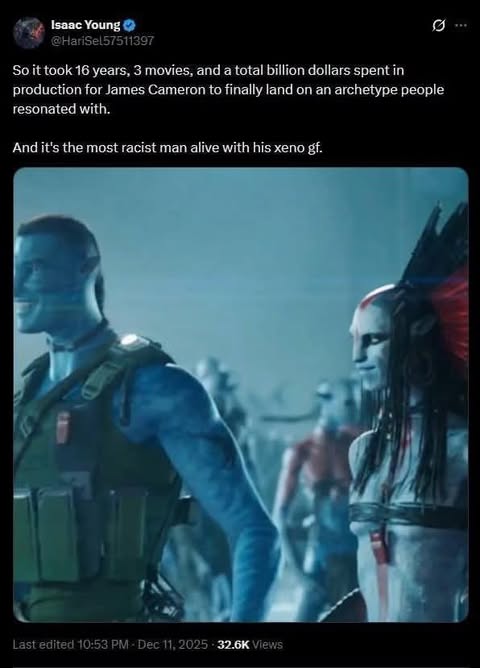
There is a theme that repeats itself in stories, myths and modern films - not because anyone invented it, but because humans recognise it instinctively.
Avatar is a textbook example.
On the surface, the film is presented as a classic story about colonialism, exploitation and technological violation. But beneath the effects and the political signals - the battle between light and darkness - the natural anchoring in the sacred fusion and union between divinity, culture and heart - standing against the godless, technocratic, cold, analytical, resource-optimising empire of intellect and brain - it strikes something far older - and far deeper.
The story of the force from outside that arrives with explanations, solutions and a higher order. Which does not merely wish to exist side by side with what exists, but to transform. And overturn. To change values, rituals, hierarchies, meaning and orientation. And which therefore - regardless of intention - is experienced as threatening.
What's interesting here is that audiences around the world instantly feel sympathy with the Na'vi people.
And this happens even though they - read through modern, ideological lenses - can quite easily be described as - closed, territorial, tradition-bound, sceptical of strangers, strongly oriented towards their own order - AND willing to use violence to defend it.
In other words - everything we today are often asked to regard with suspicion as "xenophobia" or "racism".
Yet there is no doubt who the audience is rooting for.
Stop for a moment and think deeply about why that is.
How do we all know who we're supposed to root for, almost by instinct?
Because it's not - I think - because people around the world have suddenly become reactionary.
It's because the mechanism runs deeper than ideology. Carried by a deeper Order in both our own being and the cosmos we live in.
Human communities are not built from ideas alone. They are built from anchoring. From repetition. From lived experience that has been passed on, practised and embedded in everyday life, stories, rituals, institutions and relationships - through generations. Some places through millennia.
What is Sacred is therefore never abstract.
It does not float freely.
It dwells in the concrete life that people have arranged themselves in and passed on. Even if they are not conscious of how deeply this runs in them - until it is threatened.
If we return to Avatar, it's clear to everyone that the Na'vi aren't just defending land. Or a planet.
They're defending coherence.
A cosmology.
An order where nature, ancestors, ritual and meaning are inextricably connected.
When the humans in the film arrive, they do so not only with weapons, but with a different sacred centre - technology, resource extraction, progress, universal explanations. They genuinely believe that what they bring is necessary - perhaps even good.
And precisely because of that, conflict becomes inevitable.
Because the mechanism is also activated when the invading force itself carries something it holds sacred. Something it believes in. Something it experiences as true, rational and morally right.
It changes nothing.
When the sacred from outside does not align with the existing sacred, it is still experienced as destructive. Not because it is necessarily false in itself, but because sacredness in a society and culture cannot be replaced without loss.
When someone arrives and says -
"What you live by is wrong."
"What gives you direction must be updated."
"The sacred must be replaced by something better."
...then it is not experienced as enlightenment.
It is experienced as dissolution.
Therefore the deepest conflicts in history arise not between belief and unbelief, but between incompatible sacred centres.
Two cosmologies. Two conceptions of order, truth and humanity's place in the world. Two Images of God.
Nowhere has this been more visible than in the Western world's completely failed attempts at nation-building abroad - AND in the same Western world's peculiar cultural suicide, where in misunderstood empathy it has imported hundreds of millions of people with differently arranged values, rituals, hierarchies, meanings and orientations into its midst.
This is where the modern misunderstanding arises - and where we can therefore see both sides of the coin at the same time.
The Na'vi's resistance is not about hatred of 'the stranger as person'. It's about rejection of 'the foreign order'.
It does so everywhere two strong civilisational worldviews meet each other.
But defending one's anchoring is in modern media language often reduced to morality - when in reality it is entirely predictable existential and natural response. Because it's the difference between continuing as oneself - or becoming something else.
People can adapt to much.
They can live with poverty.
They can live with defeat.
They can even live with injustice and oppression for periods.
But they cannot live long in a society where what gave their lives coherence and deep meaning is relativised, replaced or made negotiable.
Because when anchoring disappears, freedom does not arise.
Vacuum arises.
And vacuum is always filled - by power, by systems, by ideologies or by violence.
And that's why resistance is not a choice, but a reflex. Not because people are narrow-minded, but because meaning cannot be replaced without something dying.
It's not about skin colour, origin or biology. It's about continuity versus dissolution. About whether a life's order is carried forward - or replaced.
And that's why we - across cultures and continents - intuitively root for the Na'vi.
Or William Wallace and his struggle for Scotland's independence and freedom.
Not because they're perfect. But because we know how it ends when something from outside wants to live instead of us - and not with us.
Because beneath all narratives, technologies and moral rewritings, the human is still human.
And the human instantly recognises the difference between coexistence
and replacement.
Or rather.
Most do.
EU politicians have for nearly 30 years been outside the spectrum at the low end when it comes to understanding these, of all things, most obvious patterns in Man.
😲🤓🤷🏼♂️