The last two days I have written about Folk and about Faith.
About how a people is not an administrative construction - but a living organism with memory, inheritance and story. And about how all humans believe in something - and that the question is never whether one believes, but what one believes in.
Today I tie the two threads together.
For one cannot understand what a people is - and what threatens it - without understanding what it is built upon. What gave it form. What lifted it. And what happens when that foundation weathers.
Strap in.
...
There are civilisations that tower over their time.
It is never accidental and it never rests on luck. And it is not the superiority of races over one another that is the cause.
It is what happens when a civilisation finds an inner order that aligns with reality - and builds consistently upon it.
Egypt did this for three thousand years. Persia did it. Rome did it. China did it in periods of a duration that reduces our historical consciousness to nothing.
And the West did it.
From a relatively narrow corner of a small continent - cold, rain-soaked and peripheral in relation to the great civilisations of the day - arose something that over a millennium changed the world more fundamentally than anything else ever has.
The question any person of average intelligence must ask is - why?
The answer lies in a combination that has never arisen elsewhere in the same way and at the same time.
Three streams. Three sources. Three ways of understanding Man, the world and order - that braided themselves together into something greater than the sum of the individual parts.
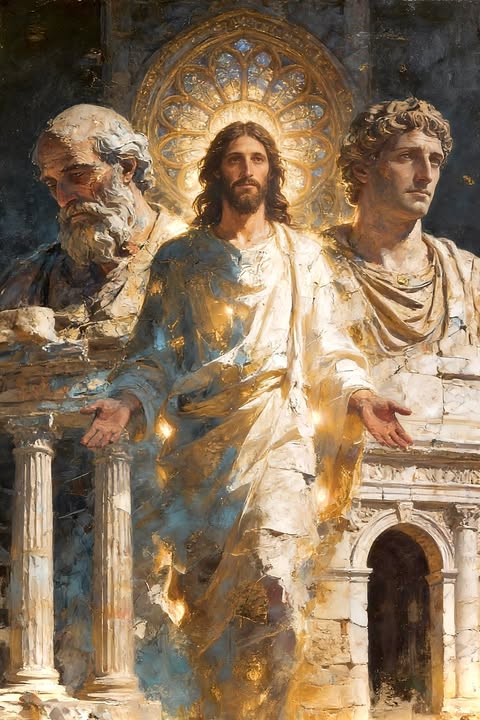
THE FIRST STREAM CAME FROM ATHENS.
The Greeks discovered - or insisted - that reality is rationally accessible. That behind the visible and transitory lies a deeper order. That this order can be reached through reason, conversation and recognition. That Truth exists - not as something we construct, but as something we discover.
And that the word describing this ordering reason behind all things - Logos - is real.
It was not just philosophy. It was a claim about the nature of reality. A claim that made science possible. That made law possible. That made the distinction between true and false possible - not just as opinion, but as something actually at stake.
And simultaneously a claim that truth cannot be constructed - but can only be discovered. And that when we nevertheless attempt to construct it - shape it according to our wishes, our ideology, our convenience - then the construction ALWAYS collapses. Sooner or later. Because reality does not bend to lies.
(It is this term - Logos - which Europe is being seriously stress-tested by in this time, when all veils fall and reality lays itself bare…)
THE SECOND STREAM CAME FROM ROME.
The Romans took the Greeks' insight and gave it body in the world. They built law. Not as the ruler's will - but as an order that also binds those who administer it. NO ONE stands above the law. Not the king. Not the Emperor. Not the priest. Not the general.
It was a revolution in humanity's self-understanding so fundamental that today we can hardly imagine what the alternative feels like from within. But most of humanity has lived - and still lives - in systems where law is the ruler's instrument. Not his master.
THE THIRD STREAM CAME FROM JERUSALEM.
And it changed EVERYTHING.
It is important first to understand what actually came from Jerusalem - for it was not an institution. It was not a church. It was not a power apparatus.
It was A MAN - who walked around saying Truth aloud.
Jesus built no institutions. He wrote no laws. He founded no state. What he did was far more subversive and far more lasting - he said something true about what a human being is. And that truth was so explosive that those in power could not live with it.
For Christianity brought something no other civilisation had formulated in the same way - that each individual human being - not the people, not the class, not the caste, not the tribe, not the nation - but the individual human being bears a divine image. Imago Dei. Created in God's image.
It may sound so to untrained ears, but it is not a sentimental claim. It is the most radical political and anthropological claim ever made.
For if it is true - if every human being bears this image - then no state, no emperor, no ideology and no majority can legitimately treat a human being as merely a means. Not the slave. Not the woman. Not the stranger. Not the weak.
Human rights are not a product of the Enlightenment's self-invention. They are a consequence of this one claim - conceived by a carpenter's son in a small province of the Roman Empire two thousand years ago.
And the church's later institutionalisation - with all it brought of power, abuse and human fallibility - does not change this. The institution is human. The claim is not.
That is the difference.
And when these three streams braided themselves together - Athens, Rome and Jerusalem - it became visible in a symbol most of us have seen a thousand times without thinking about what it means.
The cross above the crown.
It is not an empty decoration. It is a symbol that explains hierarchy. It is a declaration that earthly power has a ceiling - and that this ceiling is not set by humans.
The king is subject to the law. The law is subject to truth. And truth has a source higher than the king.
That is what the symbol says.
That is what it has always said.
And that is why it still sits there.
These three streams braided themselves together.
Not peacefully. Not without strife and blood and centuries of struggle over what they actually meant and how they should be weighed against each other.
But they braided themselves together.
And the result was a civilisation - the Western - that slowly, imperfectly and with countless setbacks - moved in a particular direction.
Towards freedom. Towards dignity. Towards truth as something that also obligates those in power. Towards an order where the weak individual has a claim to protection against the strong collective.
No other civilisation has formulated this in the same way. No other has delivered it - however imperfectly - in practice over so long a time and to so many people.
I do not write this from outside. I write it as a human being who has himself found his way back to this foundation - by detours, through doubt and through a slow recognition that what I was searching for was there all along.
Not as nostalgia. Not as nationalism. But as a living order that still bears - if one is willing to stand upon it.
And precisely because I stand there, I can see what is coming, what awaits, clearly - without illusions. Anyone who positions themselves where I stand can.
For here is what cannot be said loudly or clearly enough -
Civilisational worldviews are not just different cultures with different food traditions and holidays.
They are fundamentally different answers to the same basic questions.
What is a human being? What is law for? What is the relationship between God and state? What are man and woman? What do we owe each other - and who is 'each other'?
The Western model has its answers, which are not accidental. They have grown forth over millennia of struggle, recognition and experience.
Islam has its answers. They are not accidental either. They are just as deeply anchored - and just as total in their claim on Man and society.
And it is worth driving a stake right through here - we are NOT talking about Muslims here. It is not even people.
It is two civilisational arrangements - two fundamentally different ways of organising human life, law, the state and the sacred - that at central points cannot lie atop one another without it ending in conflict.
Not because either party desires the conflict. But because two different answers to the same question, which are opposed, cannot both be true at the same time.
Let me be a bit more concrete, and then we can press further into the darkness tomorrow -
The Western model says:
Law stands above those in power.
Islam says: God's law - sharia - stands above human legislation.
This is not a detail. It is a fundamental disagreement about what law even is and from where it derives its legitimacy.
The Western model says:
The individual human being has an inviolable dignity regardless of sex, faith and origin.
Islam says:
Man is God's servant - and within this order men and women, believers and non-believers, are not equal in juridical and social terms.
This is a completely different anthropology.
The Western model says:
Religion and state are separate domains.
Islam says:
There is no dividing line between the religious and the political - Islam is both faith and social order. Din and dawla. Faith and state. In one.
These differences are not superficial and they are not misunderstandings that can be cleared away with good will, dialogue and a bit of coffee. They are structural. They go right to the core of what the two worldviews believe man is - and what society therefore must be. Ancient and abyssal in their architecture of the soul.
It is possible to live side by side with these differences. It happens many places. Peaceful Muslims live their lives in Western societies every single day - and contribute to them.
But that does not change that when these two arrangements are pressed against each other - when population numbers shift, when parallel societies grow, when loyalty to a supranational religious order competes with loyalty to the people one lives among - then arises a tension that cannot be resolved with tolerance alone.
For tolerance is a Western virtue. It rests on the Western premise that faith is a private matter.
But for a worldview that does not acknowledge this premise - tolerance is not a virtue. It is a weakness to be exploited. As the most natural thing in the world - not because the exploitation expresses evil, but because the orientation within is different. When dominance is central in one's worldview, one acts accordingly with full conviction and direction.
Tomorrow - Good Friday - we look more closely at precisely where these collide. In the concrete. In what we already see around us - if we dare to see.
Without anger.
But also without looking away.
Good evening, friends.
❤️🔥🪽