You are not extreme. But someone needs you to believe you are.
...
I have experienced that moment myself.
Meant something - something quite ordinary, something I had meant for years, something that aligned with what most people in this country think when they are honest - and been told it was extreme.
When that word fell, something happened inside me in the same instant. Something small and almost imperceptible. An uncertainty, a kind of interior withdrawal. Doubt.
"What? Maybe it's me who has slipped into something? Maybe I have moved out toward the edge of something without knowing it?"
I know that moment from the inside.
And I know I am not the only one.
Let us talk about that moment.
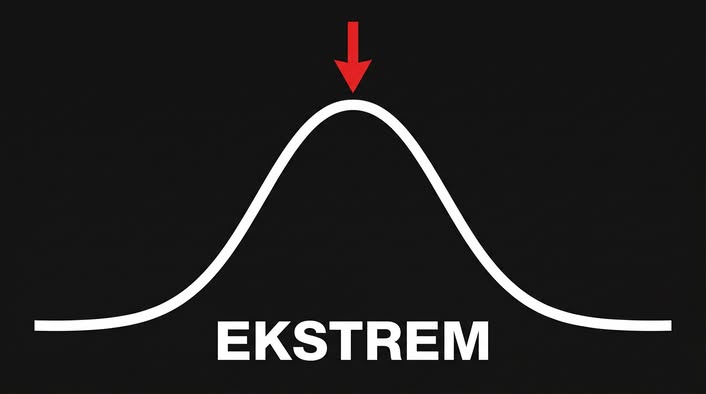
The word "extreme" is in its origin geometric. It describes a position - something that is located far from the middle, from the average, from what most people actually mean and live with. It is not a moral concept, it is a DISTANCE CONCEPT. Like "periphery" or "outermost point".
It does not say right or wrong.
It says - out here at the edge, far from the centre.
The simplest question, which is actually the most obvious in the world to ask, is therefore this in our time, when the concept is thrown around every single day.
If a position is shared by the majority of a population - what then is the distance to the middle? What geometry are we talking about when the position is the middle? It cannot make sense to call a majority opinion extreme, unless one has quietly and gradually allowed the word to mean something other than it always has.
But that is precisely what has happened.
"Extreme" no longer measures what people actually think. It measures what certain institutions, media and political environments have decided it is acceptable to think. The two things are not the same. And they have begun to diverge markedly - and in that distance, in that void, something has arisen that resembles censorship, just without a censorship authority. It is not because anyone forbids anything. It is unnecessary. People edit themselves, lower their voices, withdraw - not because they have slipped out toward a fringe, but because they have been convinced that it looks like it.
And it is so important to understand, in the current period where we live inside a true bombardment of an information war - where actors want something from us. Nonstop around the clock. So read the next sentence a couple of times until it sits firmly.
A psychological mechanism does not need to be visible to work.
It only needs to sit inside us.
Take the position on immigration. Opinion polls have shown the same thing for twenty years - a clear majority wants a markedly stricter policy. That position has in those same twenty years been systematically described as xenophobia, nationalism, right-wing extremism or worse. Not because it was marginal. But because it was uncomfortable for those who held the definition.
Take the position on biological sex. The majority of Danes believe that biological sex is real and relevant. In media, parts of political life, cultural and academic institutions, that position has been called reactionary and transphobic - not by a majority, but by those with the microphone.
Two issues. Very different. Same mechanism.
And the list of issues this has been done with is endless.
And the pattern reaches deeper than our own decade, our generation or the last century. Let me give just one example.
Every single society we know of, across cultures and millennia, has organised itself around a form of transcendence - a sense that existence contains more than the measurable. This is not superstition. It is a pattern so consistent and pervasive that it tells us something about Man's structure, not about his unenlightened past. Take for example New Atheism that stepped onto the scene some 20 years ago - which presented itself as the rational middle, the self-evident standpoint all modern thinking people should adopt - is in historical context one of the most marginal viewpoints any human has ever taken. A small blip in a single cultural epoch, which convinced itself that all who had gone before had merely been searching for comfort in chaos. It is already beginning to fade. And held up against 200,000 years of human history with faith and transcendence, new atheism is a phenomenon that did not even survive a generation as cultural dominance. That is how "normal" it was. Or rather. How abnormal and extreme it was.
For the mechanism works in both directions. It calls the centre extreme. And it calls the outermost point self-evident.
The question to ask - now and going forward, every single time one meets the word - is the simplest conceivable -
Extreme in relation to what? In relation to what people actually think? Or in relation to what certain voices - The Man on Television - "The Experts" - The Machine - The Programme - have decided that one may think?
For those two questions are not the same.
That small movement from within - the withdrawal you know, the uncertainty that arises when someone points at you with that word - extreme - it is not an answer to what you actually are.
It is an answer to what you have been told you are. And that, my friend - that is absolutely not given to be the same thing.
❤️🔥🪽
Good Sunday evening, friends.
Enjoy the sun next week. ☀️