So there's finally some news from -
THE CENTRE FOR SOFT MEAL TRANSITION
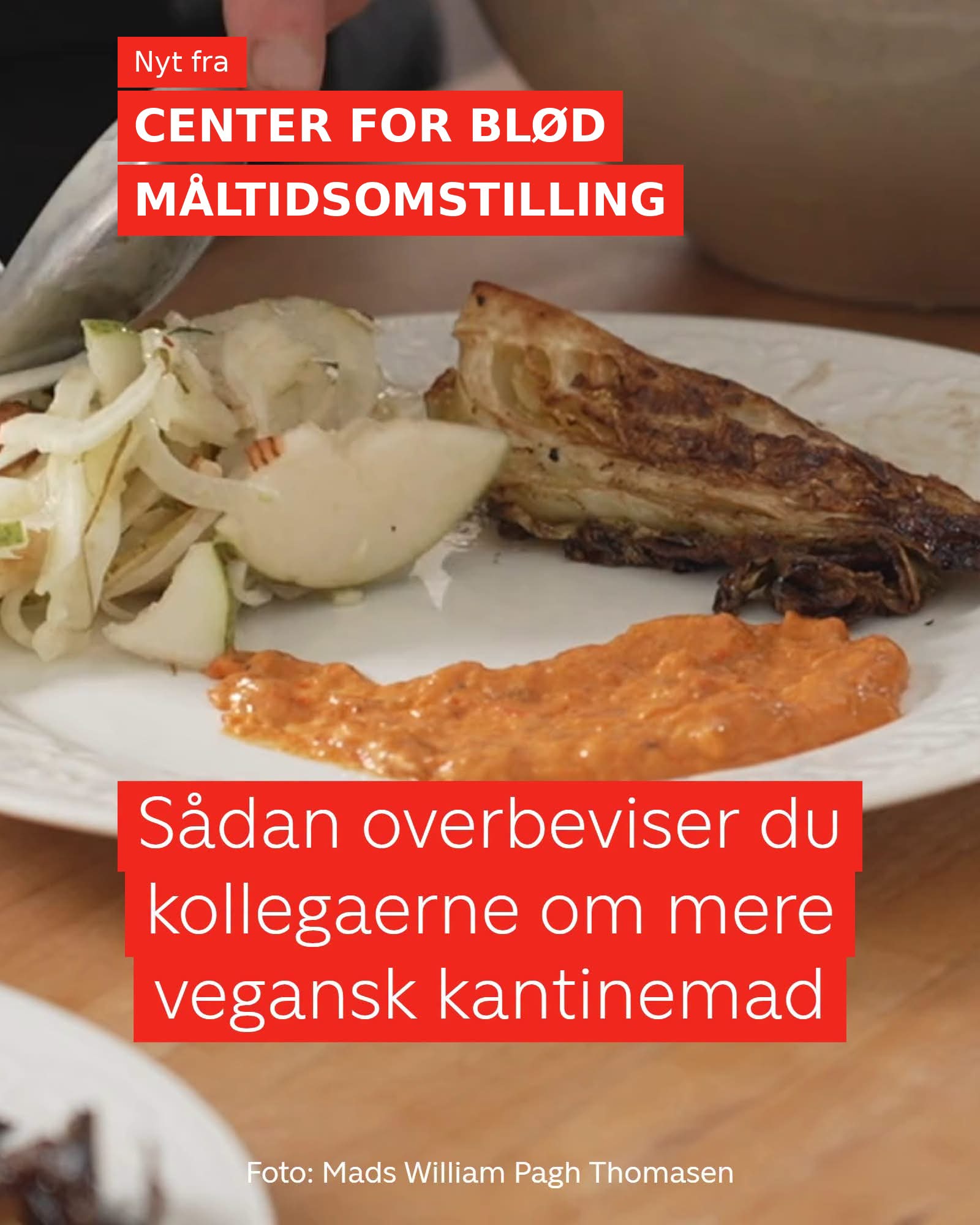
There's half a roasted pointed cabbage on a white plate, a dollop of red sauce next to a small pile of fennel and apple, and at the top of the picture there's a hand with a spoon, about to come in and just adjust it all a little before the photo is taken.
And that's actually where the whole story already stands, if you're willing to look one second longer than usual.
TV 2 Fyn reported yesterday - TV 2 nationally today - that the University of Copenhagen has asked 891 Danes between 18 and 69 years old whether they'd like more plant-based food in the canteen - and that the resistance, hold on tight here, turned out to be - I repeat that you should read the word slowly - SURPRISINGLY widespread…
Surprising… to whom, one might ask?
At least not to the 891.
They knew it well. Just as anyone with half a functioning brain could have predicted the answer. The 891 have, along with the rest of the country, known it every single day at noon for many years.
The "surprising" thing here isn't the answer, the surprising thing is that anyone expected something different, and that you had to use a research budget to find out what any canteen lady could have told you for free between two portions of meatballs.
The lecturer quotes the typical reaction like this -
"No, bloody hell no, nobody's going to lecture me about what I should eat."
That's a clear answer.
It's actually one of the clearest answers Danish social research has ever produced, so congratulations on that to the "research team".
And here you'd think that a study that lands there would end there, with a conclusion that people prefer to decide for themselves what goes into their own body, and that this is perhaps, after all, a very healthy thing to have in a free country.
Yes, it's just a thought.
But the article doesn't end there. The article continues. Because the headline doesn't say "what Danes think about the canteen". The headline says - "How to CONVINCE your colleagues."
Not offer. Not serve. Convince.
And the man who's going to help you with that isn't a food consultant. He's a food and behaviour consultant, and it's not the first word that's the position.
It's not a coincidence in the title. It's a description of the job. A whole little bureaucracy has by now grown up around your lunch, choice architects and meal facilitators and green canteen ambassadors and swan-labelled ISO70080 certified transition advisors - and what they have in common isn't that they make food. They probably can't figure that out. Because food is completely secondary.
They make people.
And you can almost hear the names of the workplaces that house that sort of thing come by themselves -
Centre for Soft Meal Transition.
Secretariat for Voluntary Compliance.
Unit for Reduced Resistance.
Task Force for Gentle Dietary Change
- and the only thing separating them from reality is that they haven't yet got a logo manual, a postbox at Slotsholmen and a press officer who can explain that this isn't about coercion - but about frameworks. For your sake. Obviously.
His advice is that the plant-based should be served attractively, and, verbatim, that it shouldn't be served as being anything special, which in all its innocence means that the colleague preferably shouldn't notice what's happening while it's happening.
You shouldn't lie, that's not what he's saying.
You should just refrain from drawing attention to it. You should, as he says… inspire… the management or the canteen staff, in other words talk to those who decide about the plate, instead of to those who have to eat from it - and that way you've solved the problem of the 891 no's by simply moving the conversation to somewhere they're not invited.
It's a strategy we know from both Parliament and the EU. About for instance, oh yes, immigration and family reunification, the number of genders and whether physical cash is very nice to have, that sort of small thing.
And now also your food. Because it MUST be green and CO2-neutral.
And then notice what the word resistance does to a no.
A no is something you answer. Resistance is something you encounter. A no has a person behind it, resistance has nothing behind it except friction, and friction isn't something you listen to, friction is something you reduce. The second your answer has been renamed as a barrier, you've stopped being a citizen who has said something, and become an obstacle that must be handled, and all the further work is no longer about convincing you - but about getting around the place where you're standing.
And notice that nothing ever gets removed. It gets balanced. The meatball isn't abolished, it's downgraded in frequency.
Green Thursday isn't mandatory, it's just the only dish. Until it's "green Thursday" five days a week.
A dialogue meeting is held about it, and at the dialogue meeting the concerns are taken seriously, which means they're written down, and a concern that's been written down is a concern that's been handled.
He even says himself that you don't go to lunch to eat climate-friendly, but to eat something delicious and get full. That's true. That's touchingly true. It's just also the whole point, said out loud by the association whose raison d'être is that you go to lunch to eat… climate-friendly.
As if it has a single thing to do with what your taste buds prefer, or with the way today's lunch is sold to you.
Because this is the new form of food morality, and it's a further development.
The old version was liveable with, there you sat with your own lunchbox and your own principles and your own mild sorrow over the others' liver pâté, and that was completely fine, it was actually almost cosy.
But it's no longer enough to decide about your own plate. Now the others' have to come along too. Not by prohibition, because that would look ugly, and not by vote, because that's just been held and lost, but by "advice", by "inspiration", by "friendly circumvention of a no" that you've just used scientific resources to confirm exists.
And then there are the names.
Because when the dish mustn't be presented as anything special, then you can't call it what it is, and therefore it's called something else. Vegan burger. Pulled oats. Bacon-like strips. Chili sin carne, a dish named after what it doesn't contain, which must be the closest gastronomy has ever come to a tax return.
There's something almost touching about a movement that condemns meat and simultaneously can't help but name every single thing after it.
And as a final little gift to posterity, the Danish Vegetarian Society recommends potato bread and burning love as climate-friendly dishes.
Burning love is mashed potatoes with fried bacon.
You can probably take the bacon out of the dish. You just can't take the dish out of the bacon.
That leaves us with a single remaining explanation.
It's not the food they want into the canteen.
It's the consent they want out.
Take my advice.
Just say - no thanks, I'm an adult.
🤓🤷🏼♂️😁
Happy Thursday, friends ❤️☀️